







AI advice in local SEO tends to come in two flavors: hype, or a list of prompts to paste into ChatGPT. Neither tells you much about what AI actually looks like inside a working agency. What matters there is how those agencies can improve the work they’re doing for their clients. Whether that’s in efficiencies or quality. The more time saved on previously manual tasks like reporting, the more proper work they can do for their clients.
So we asked someone who lives in it every day. Noah Learner is Director of Innovation at Sterling Sky, and he sat down with our CEO and co-founder, Myles Anderson, to talk through what he’s built, including reporting that used to cost the agency more than 100 hours a month, what’s broken, and what he’s still not ready to hand over to a machine.
We’ve written about what AI means for local SEO before, and asked a panel of experts for their take back in 2023. But with both customers’ adoption of AI search and more marketers using it to improve their workflows, we wanted to find out who is doing what.
So our talk with Noah is different. We’re focusing on exactly how he’s using AI to do better work at Sterling Sky. And we’ll be talking to others just like Noah in the near future.
Noah’s AI tooling timeline: from ChatGPT tabs to Claude Code
Noah’s AI journey started in 2021, with early access to OpenAI’s API. Where he got so into it, he quickly ran out of tokens.
“I blew through the whole wad in the first query that I ran. I was sharing tokens with other people, so I was like, yeah guys, sorry, my bad.”
As is the same for many, those early days of AI were mainly just playing around, though. The real shift came in late 2023, at a local SEO conference in Canada, where Marie Haynes challenged him on not using AI in his workflows. He started moving tasks into ChatGPT in the browser, then into VS Code with Copilot, then through a run of other tools before landing on Claude Code, where he’s stayed for about a year.
His day-to-day now runs through an editor called cmux, with several build streams going at once.
“Every single tool that I’m producing now is built with AI … I’m looking at about 25% of the code. I’m not looking at all of it, and I’m not looking at none of it.”
His latest edition is remote control, which lets him kick off and steer builds from his phone. He’d only started using it the week before this conversation.
Rebuilding client reporting for local SEO from scratch
Ask Noah what’s eaten the most of his time since he joined Sterling Sky, and the answer is immediate: reporting. There was no single, unified way to report to clients, and the move to GA4 forced the issue at the same time.
His goal for the year was to move reporting off Looker Studio and into an application built by the Sterling Sky team. And this is on track to roll out for their July reporting cycle.
Building the reporting himself let him do things Looker Studio simply wouldn’t allow:
- Break leads down by channel and view GBP leads on their own
- Build layouts that actually work on a client’s phone
- Toggle between percentage change and raw numbers
- Add annotations tied to a specific month so an account manager can explain what happened, not just show a chart.
“The ability to really break free of constraints has been really, really amazing,” he says.
If you’re still setting this up on your own reports, our guide to getting started with GA4 for local SEO covers the basics. BrightLocal’s own AI Insights is aimed at the same problem: turning reporting data into something a client actually understands.
Plus, you can use BrightLocal’s MCP to get your local search data and GA4 data talking to each other.
Looker Studio is under-reporting your leads
Along the way, Noah found something worth knowing if your business is paid on the leads you can prove: Looker Studio under-reports leads. Consistently, if quietly, by “less than ten percent.”
Part of the cause is technical. GA4 samples data on busier sites, especially when you’re counting by event rather than by session, and phone calls often never reach GA4 at all. Part of it is a decision every agency has to make and defend: what actually counts as a lead. A phone call? A form fill? The first time someone found the business, or the last session before they converted?
Building the reporting themselves, let Sterling Sky handle this properly: combining ads data with organic data in code, rather than defaulting to GA4 alone and under-reporting the leads paid search was actually driving.
How Sterling Sky decides what to automate
Noah’s approach to automation follows one rule: find the task costing the most hours across the most people, then build for that first.
Reporting made the cut because the math was stark. Sterling Sky was spending upward of 100 hours a month on it across the team, more than one person’s full working month. The same logic drove their internal screenshot tool for mobile SERPs, built because nothing decent existed for it on the market.
Priorities get set monthly in a meeting with Joy, Sterling Sky’s founder. Some projects take a quarter. Some take a week. Some take a month of chasing bugs that never quite got bad enough to fix.
Testing your way through AI search
Sterling Sky spends “tens of hours” a month, more than ten but less than a hundred, testing on-page and off-page tactics for AI search, an area our own research shows is making local listings more important than ever.
Noah is candid that testing hasn’t yet earned the same automation investment as reporting; it hasn’t hit that hour threshold, at least not yet.
What he is clear on is the mindset it takes: humility about what you actually know, and a willingness to test your own assumptions rather than defend them. Press releases are one tactic Joy has spoken about publicly. Beyond that, Noah is careful about which specific techniques he shares.
He tells a story from Google I/O 2025, where Sterling Sky and others pushed Google’s engineering team to build a Search Console for AI search. Google’s answer at the time: no tooling until the SERP settles down. (Note: Google has since shipped this when Search Console added generative AI performance reports in June 2026.)
For Noah, the uncertainty wasn’t a reason to wait.
“Winning in search equals delivering experiences that make our clients more money … We’ll test whatever we’ve got to test in order to accomplish that goal.”
We’ve launched our own local AI visibility tracking to help businesses see how they’re showing up in local AI search, and would recommend it as a great place to start.
What this means for your agency
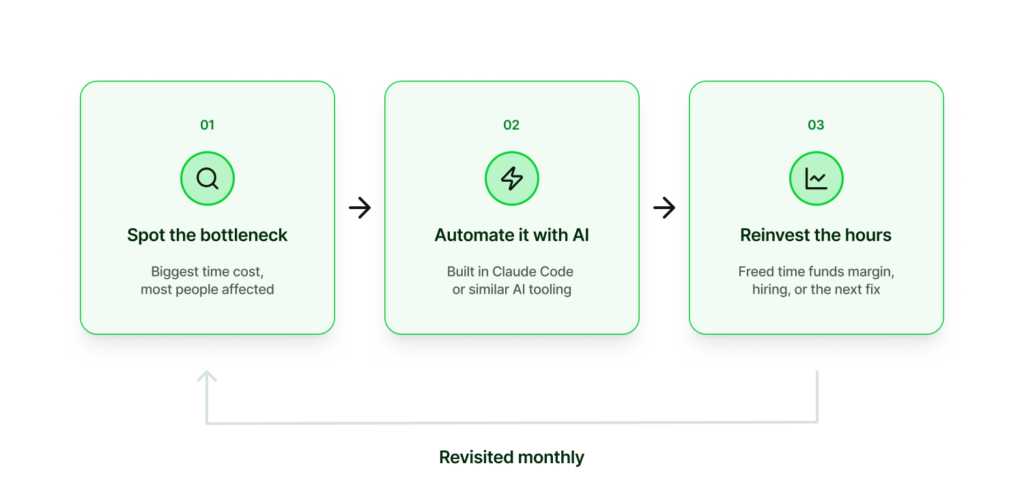
Noah’s approach comes down to a simple discipline: decide what to build, and what to leave alone, before reaching for any new tool. Three things worth taking from it:
- Build a testing habit for AI search, even a small one, rather than waiting until you feel ready.
- Check your own reporting for blind spots like the one Noah found. If leads are quietly under-reported, your clients aren’t seeing the full value of your work.
- Before you reach for AI to fix something, find the bottleneck costing the most hours across the most people first.
That’s the order Sterling Sky builds in, and it’s the difference between automating for the sake of it and automating what actually matters.
As Noah puts it: “If agencies and individual consultants aren’t working that way, it’s gonna be a short career.”
We’ll be talking to more search experts in the near future on how they’re using AI to do local SEO.