







Key findings
-
Google dominates, but isn’t the only channel that matters: Searches may be most likely to start on Google, but 3/4 of consumers used multiple channels in their most recent search for a local business
-
Most local searches happen on the go: The majority of consumers searched using a mobile device, making a mobile-friendly presence essential
-
AI is in use, but verification is still key: Most consumers who used AI in their search went back to Google or another channel to verify before making a decision
Most local businesses can’t just rely on customers wandering in through the front door. In the last three months, 84% of consumers searched for a local business online. If you’re not showing up where customers are looking, you’re not in the running.
We set out to create the definitive report on what local businesses need to understand about consumer behavior online. The first part showed how quickly consumers make a decision, and how many businesses they consider before making it. (Missed it? Catch up here.)
Here, we’ll be exploring where these decisions happen. Which channels are consumers actually using? How does a search start, and where does it go from there? And where does AI fit into all of this?
If you want to know which platforms to prioritize in 2026, read on.
Searches start on mobile
Most local business journeys start in the palm of your hand. We asked consumers about their latest local business search, and for 73% of respondents, this started on mobile. Just 19% used a computer, and 8% on a tablet.
| Mobile phone | Computer | Tablet | |
|---|---|---|---|
| 18 to 29 | 71% | 19% | 9% |
| 30 to 44 | 86% | 12% | 3% |
| 45 to 60 | 77% | 15% | 8% |
| Over 60 | 57% | 33% | 11% |
| Overall | 73% | 19% | 8% |
Device use shifts a little depending on age. Older consumers are more likely to look for local businesses on computers or tablets than younger generations. But mobile is still the most used device across all age groups.
If your website doesn’t work well on a small screen, or you just don’t show up in mobile search rankings, you risk being invisible at the exact moment someone is looking for you. Think slow-loading pages, social media profiles without clickable contact information, or images that are hard to make out. Small friction points like these could send potential customers straight to a competitor.
Start with Google. Your customers will.
It’ll come as no surprise that Google is important. But with all the chatter about AI’s growing dominance, small business owners may be wondering if it even matters to still prioritize Google.
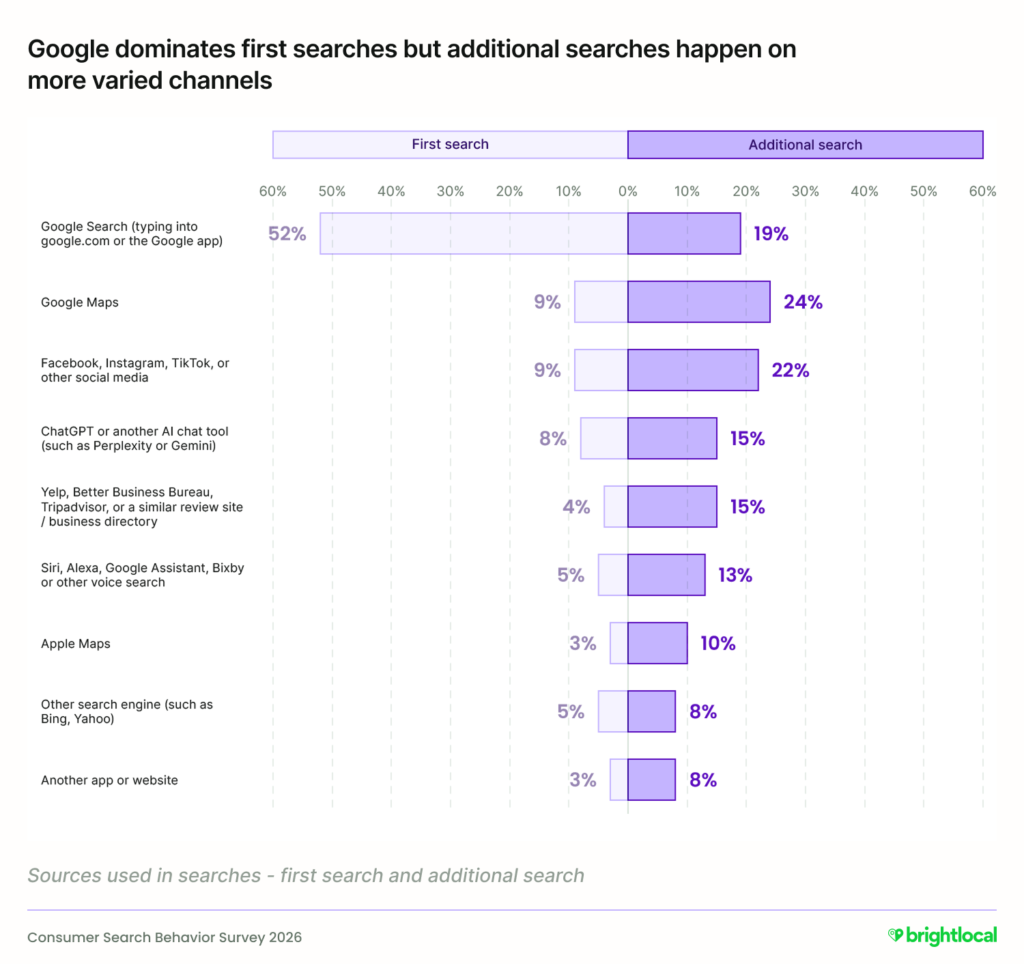
The data is clear: Google should still be your #1 priority before you start worrying about other channels.
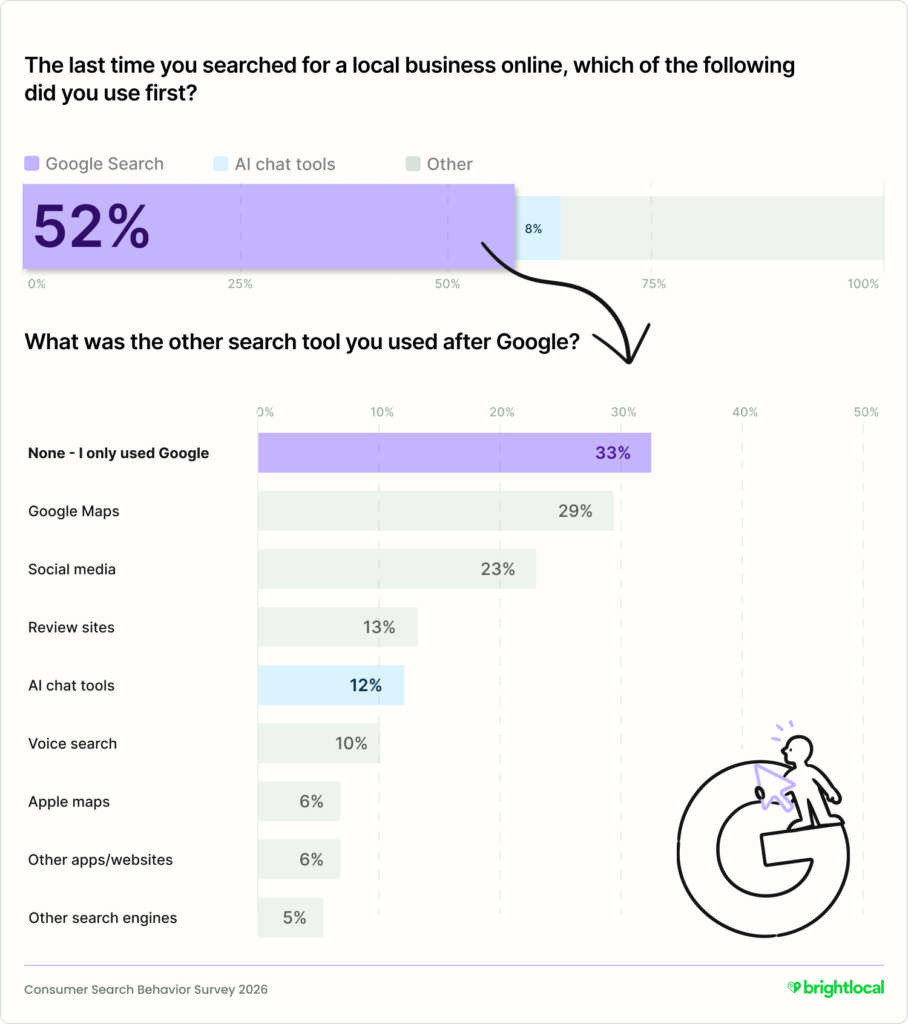
More than half (52%) of consumers started their most recent local business search using Google Search, with a further 9% starting on Google Maps. This is actually slightly up from last year, when 60% of consumers said Google (45%) and Google Maps (15%) was their default for local searches.
And when you look at the full journey, 71% used Google Search at some point during this search. Whatever else is changing about the way people search, Google remains the most important place to be.
Looking beyond Google, this means that 39% of these searches started on a different channel, whether that’s social media, AI tools, review sites, or something else entirely. None of these channels account for a significant proportion on their own, but together they raise the question: is Google enough?
One channel is rarely the whole story
While Google is the first place most people make a local search, most don’t stop there.
75%
of consumers used more than one channel during their most recent local business search.
In part one of this research, we found that most people make a decision on a local business in under 30 minutes, with 28% deciding in less than five minutes. But quick doesn’t necessarily mean simple. Consumers are moving between multiple channels, gathering all the information needed before making a call.
While non-Google channels don’t get much of a look in as the starting point for local searches, it’s a different story when looking at the entire journey.
Social media, AI tools, and review sites are all part of the picture: used by 30%, 23%, and 19% of consumers respectively. Just because a channel isn’t where most people start doesn’t mean it doesn’t matter. Every channel plays a part in building confidence before a decision is made.
Even consumers who started elsewhere commonly used Google during their search. Around two in five who began on social media, AI, voice search, review sites, or Apple Maps returned to Google before making their decision. Whatever channel your customers start on, chances are they’ll use Google too.
AI is tested, but not yet trusted absolutely
AI tools may not be the first place most consumers turn when searching for a local business, but it’s clearly in the mix with 23% using it during their most recent search.
Zoom out beyond the most recent search, and usage looks higher still. 31% of consumers use AI tools for local business recommendations on at least a monthly basis. Only 19% said they wouldn’t consider using AI to find a local business.
This backs up our recent Local Consumer Review Survey findings on AI’s rapid rise. We found that 45% of consumers used AI tools for local business recommendations in the last year, up from just 6% the year before.
And with AI now being built directly into Google Search, it’s going to get harder and harder for naysayers to avoid.
But being used isn’t the same as being trusted.
Looking at consumers that are already using AI for local searches, only 18% felt ready to contact the business recommended by an AI tool. The remainder continued to research using Google and other channels to verify details or get more information. AI may rapidly be becoming part of the journey, but it’s not yet in a place where consumers feel they can trust it.
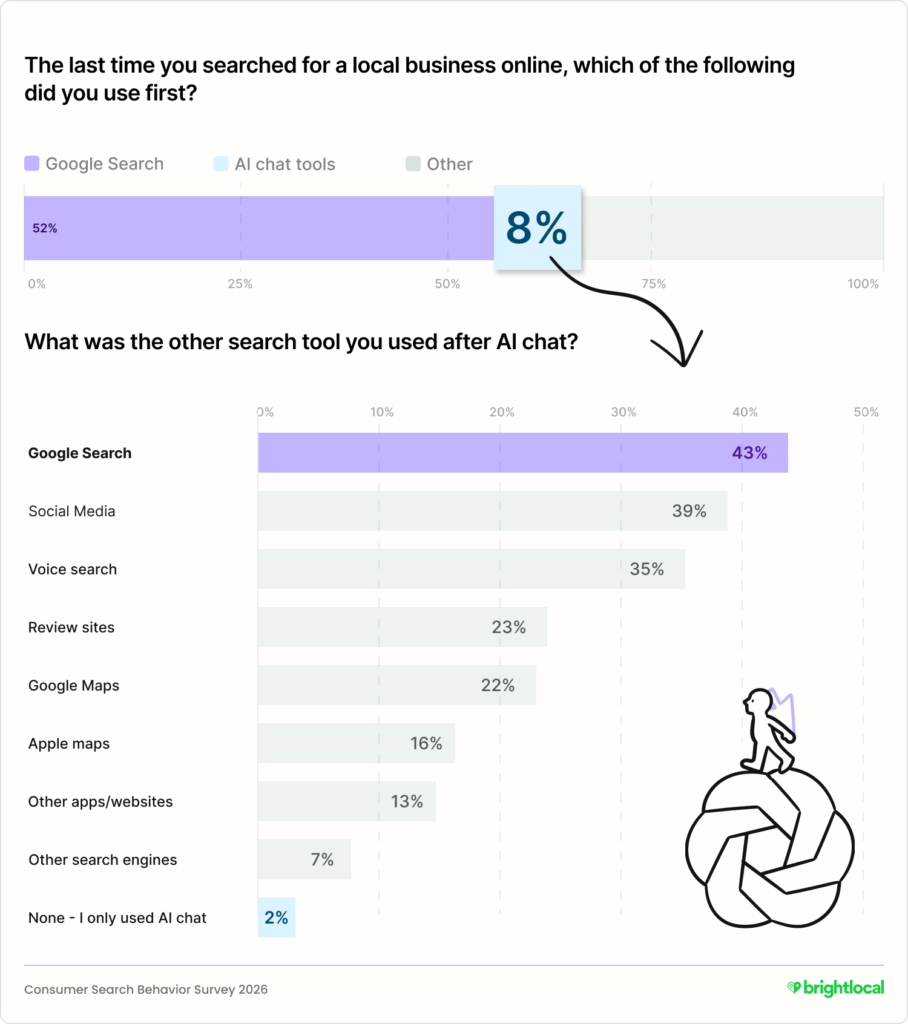
We can see this played out more by looking at users’ most recent search. Of consumers who started on an AI tool:
- Just 2% used it as their only channel
- 43% went on to check Google
- And 39% looked at social media
Compare that to consumers who started on Google Search: 33% stopped there, satisfied with what they found.
For local businesses, AI visibility is quickly becoming part of the picture, but it doesn’t replace the need to show up in more traditional channels online. And, with channels like Google embedding AI directly into search results,the line between using AI and choosing other channels is becoming blurred.
Consumers are using AI to shortlist, but not always to decide. The businesses that get chosen are the ones that hold up when customers go to check the finer details.
That means knowing what AI tools are saying about you, and making sure your information is consistent and easy to find across every channel your customers are using. Because if the details don’t stack up when they go to verify, you won’t make the cut. Local AI visibility tracking is a good place to start.
Is your business being recommended by AI?
Be where your customers are looking
Local search isn’t a single click, it’s a journey. If you only have space for one channel, the data is clear: start with Google. But don’t expect your customers to stop there.
The businesses that show up across the whole customer journey are the ones with the best chances of making the shortlist. And, as we found out, that shortlist is truly short!
To make sure your business shows up wherever your customers are looking:
- Claim and optimize your Google Business Profile so you can show up in local searches
- Check your website works well on mobile, with fast load times and easy-to-find contact information
- When you track local rankings, make sure you also track mobile search rankings as well as desktop, as your position on each can be very different
- Keep your presence on social media, review sites, and other channels accurate and up to date. Consider if a listings management tool can help you do that.
- Pay attention to what AI tools say about your business, and be ready for customers to fact-check these details
Now you know how long consumers take to make a decision, and the channels they use to do it. In the next part of the series, we’ll be looking at what makes them click, and what makes them scroll on by. It might be the most useful insight into small business customer behavior yet.
Methodology
This report was conducted using a representative panel of 1,227 US-based consumers that had conducted an online search for a local business in the last three months.
Publications and individuals are welcome to use our research findings, graphics, and data, citing BrightLocal as the author and the page URL: https://www.brightlocal.com/research/consumer-search-behavior-channels/
Want to make sure you see BrightLocal’s key updates on local search? Click this link to make us a ‘preferred source’ on Google search. (Learn about preferred sources)