





Key takeaways
-
There is change in the list of businesses recommended when running the same prompt repeatedly for local queries. But, businesses reappear 50%+ of the time.
-
Ranking on Google Maps doesn’t translate directly to AI visibility. Google Maps mentions a tracked business in 66% of searches vs 32-38% for AI surfaces.
-
ChatGPT mentions the most businesses but the average across platforms is 2-4.
-
Your website still matters. 93% of all unique domains used as sources were business sites, and they make up 42% of all citations.
Google Maps has long been the gold standard in visibility for local businesses. But what if showing up in Google Maps doesn’t correlate with showing up in an AI search results? And what if each time an AI recommends businesses, the businesses it names change?
We used our Local AI Visibility Tracker to analyze 200,000 non-branded prompts across multiple report runs, and 1.9 million AI citations, to find out.
We wanted to see what happens when you:
- Run the exact same prompt several times in one location
- Ask a different platform the same prompt
- Move the searcher’s location, even within the same town
We found that there’s a lot of change across each of these variables. But what does that mean for you?
Find out what those 200,000 searches told us about localized AI search results, and see what you need to do about it.
How did we do this?
We reviewed 200,085 localized searches on three AI platforms; ChatGPT, Google AI Mode, and Google’s AI Overviews. This was across 1,300 business locations.
Each search takes a non-branded prompt that a local business could be recommended for. We then ran the same prompt again a number of times across a time period, and across multiple points on a map, to see whether there was any variance in the businesses returned.
For example:
We run the same search across all three platforms. Then re-run a number of times across a 60 day period.
We’d log the businesses that were recommended by each platform each time. Doing this manually could look something like this for one AI platform.
Search prompt: “need an emergency dentist open late in brooklyn tonight”
Businesses recommended for each run:
| Run one | Run two | Run three |
|---|---|---|
| Willoughby Dental | Willoughby Dental | Willoughby Dental |
| Emergency Dentist Brooklyn | Emergency Dentist Brooklyn | |
| NYC health + hospitals | ||
| Williamsburgh Dental Works | ||
| NYU Langone Health | NYU Langone Health |
From this you can then see how much change there is between the recommended businesses in each search run. This would be the variance. You can also see how much a business reappears, which would be the persistence. We can also count the number of businesses recommended.
We also did the same searches across multiple points in the same city.
There is significant variance in recommended businesses when running the same prompt repeatedly for local queries. But, businesses reappear 50%+ of the time.
Only 20-33% average overlap between result sets on repeat searches (ChatGPT 23%, AI Mode 21%, AI Overview 33%).
A business that appears once is seen again in about half of subsequent attempts (50% persistence for ChatGPT and AI Mode, 58% for AI Overview).
71-80% of businesses appear in half the attempts or fewer, so inconsistent inclusion is still expected.
In January 2026, Rand Fishkin of SparkToro did a study that highlighted just how inconsistent AIs were at returning brands or products. Rand found that there’s less than 1 in 100 chance that ChatGPT or Google’s AI will give the same list of brands twice in 100 runs for a prompt like ‘What are the top chef’s knives, brand and model, for an amateur home chef with a budget <$300?’.
But one of the things that stood out to us was their observation that the frequency a brand shows up is tied to how many competitors exist in a space. And, as you can imagine, in local search, that pool is often much much smaller. So we wanted to check ourselves, to see whether this narrowed pool of potential businesses did make a difference.
We found that there was still fairly significant variance, but it was at a much lower rate than more general AI searches. We also found that each platform had its own variance.
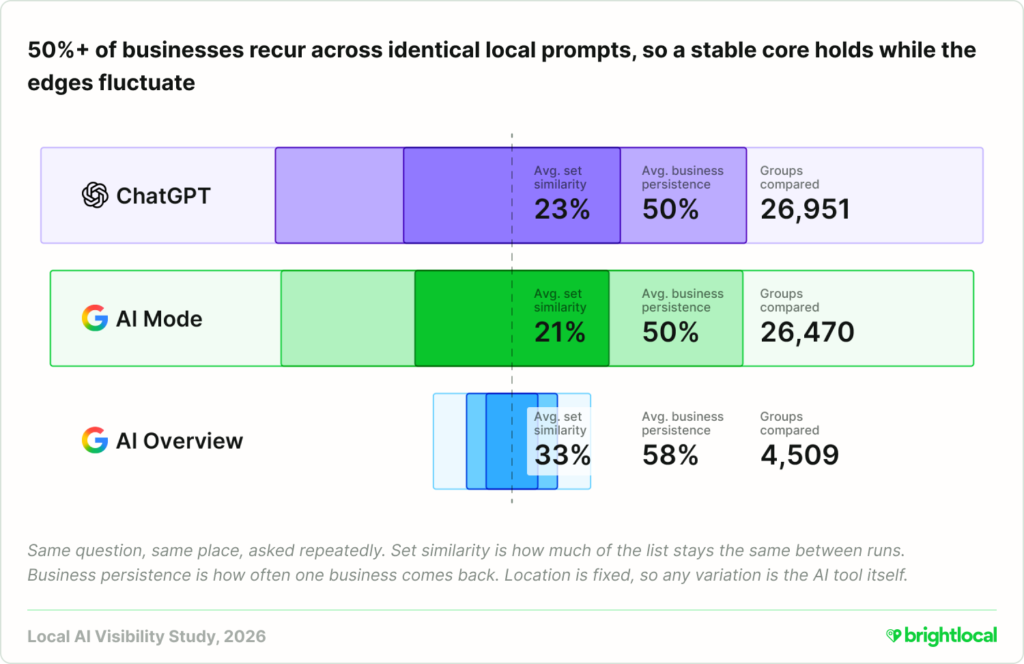
Between multiple runs of the same prompt, AI Mode saw the biggest changes, but ChatGPT wasn’t far behind. AI Mode saw 21% and ChatGPT 23% of each set being similar. So what does that mean? The average similarity isn’t just based on the specific businesses mentioned. It also includes the number of businesses returned.
Essentially:
- If you run a prompt 4 times, a single business is likely to appear in two of those.
- But, across those 4 prompts, the answers will have a different set of businesses, and in many cases a different number of businesses, mentioned in each of them.
A manually performed example of what this could look like across 4 runs of the same prompt on ChatGPT:
Prompt: best pizza place in manhattan for a tourist that only has time to try one pizza
| Run one | Run two | Run three | Run four |
|---|---|---|---|
| John’s of bleecker street | John’s of bleecker street | ||
| Joe’s pizza broadway | Joe’s pizza broadway | Joe’s pizza broadway | Joe’s pizza broadway |
| Prince street pizza | Prince street pizza | Prince street pizza | |
| l’industrie pizzeria – west village | |||
| Lombardi’s | |||
| NY Pizza Suprema |
Any controversy on what ChatGPT has picked aside (I’m an NY Pizza Suprema guy myself), you can see each one had a different number of businesses, but there were a couple of businesses that featured either every time, or multiple times. In these four responses, the businesses mentioned are similar, but the sets of returned businesses are different every time.
For this individual example above:
- 43% similarity between runs on average
- 50% persistence on average
As you can see, one of these responses added in an additional 3 businesses that were only mentioned once. This brings the whole average down for persistence and similarity. These occasionally longer lists make it appear like there’s less similarity between responses than there actually is.
Google’s AIO has a higher consistency than the others. It also had fewer searches, due to AIO not showing up for as many responses, whereas the others are guaranteed to have a response of some kind. The higher consistency could simply be down to its grounding in traditional search, but as you’ll see in the next section, it also has the smallest list of businesses on average.
Implement AI visibility tracking to uncover competitors to get important actions
You won’t always show up, and that may be OK, as you could show up next time. But, and it is a but, you should be keeping an eye on this. Only showing up in one of every two searches is one thing, but only showing up in one of every 10, for example, is another.
Putting everything down to volatility leaves too much on the table to chance. Yes, the businesses AIs mention will change, but they don’t all change, and some businesses will recur more frequently than others. And you can bet it’s the ones putting in the work.
We’d recommend tracking your presence in AI and making a note of who else is being mentioned or cited across a period of time. See what you can do to get ahead of them. Whether that’s doubling down on getting more reviews, getting listed on specific local or industry directories, or simply tweaking your Google Business Profile (GBP) category.
Is your business being recommended by AI?
ChatGPT surfaces the most businesses but the median across platforms is 2-4
ChatGPT averages 4.1 businesses per response (range 1-7, median 4)
Google AI Mode averages 3.5 (range 0-6, median 4)
Google AI Overview averages 2.5 (range 0-4, median 3), the most limited of the three
Empty responses aren’t rare either: 10% for ChatGPT, 11% for both Google surfaces
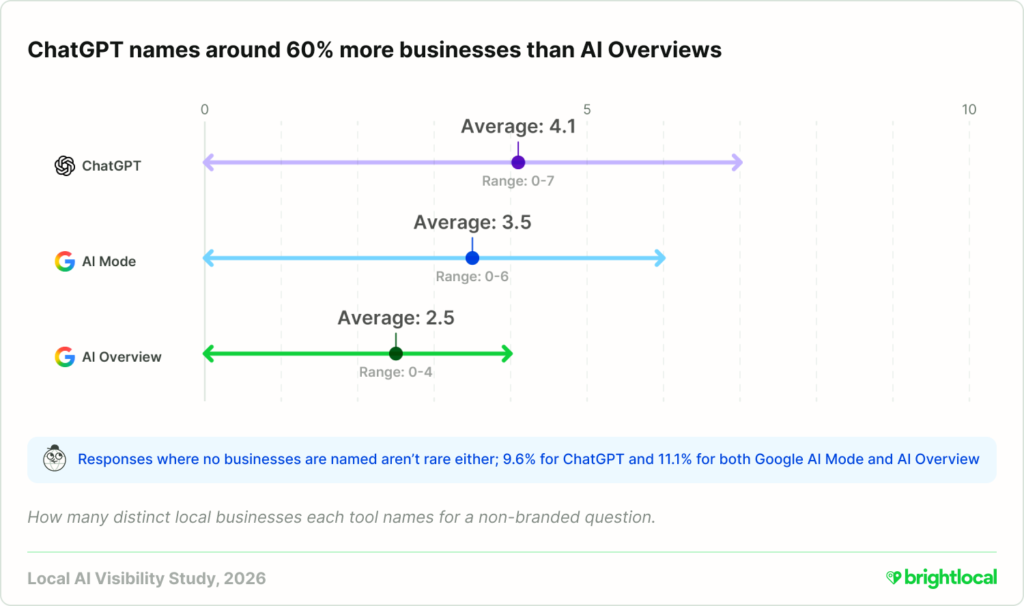
ChatGPT, on average, returns over 4 businesses for each prompt. AI Overviews has, by far, the tightest number of recommendations, and when you consider what a traditional Local Pack looks like, that makes a lot of sense.
Compared to traditional search, this fluctuation in responses is one of the main reasons there isn’t huge consistency between answers. Each response can have a different number of businesses mentioned, as well as a different set of businesses.
This shouldn’t change a great deal about your local search strategy, but it’s good information to have to help provide context to other findings in this study.
Ranking on Google Maps doesn’t translate directly to AI visibility, and each platform doesn’t agree entirely.
Google Maps mentions a tracked business in 66% of searches vs 32-38% for AI surfaces (AI Overview 38%, ChatGPT 33%, AI Mode 32%)
Maps is also far more stable: 99% average agreement across attempts vs 91-96% for AI platforms
Platforms disagree with each other too: AI Mode and AI Overview share only 29% of businesses; ChatGPT overlaps just 19-20% with either Google surface
While it’s widely considered that good local SEO is good local AEO (are we calling it local AEO, reader?), it’s notable that Google Maps mentioned a tracked business on average 66% of the time, when the AIs only mention them 32-38% of the time.
This shows that success in Maps doesn’t necessarily lead to success in an LLM.
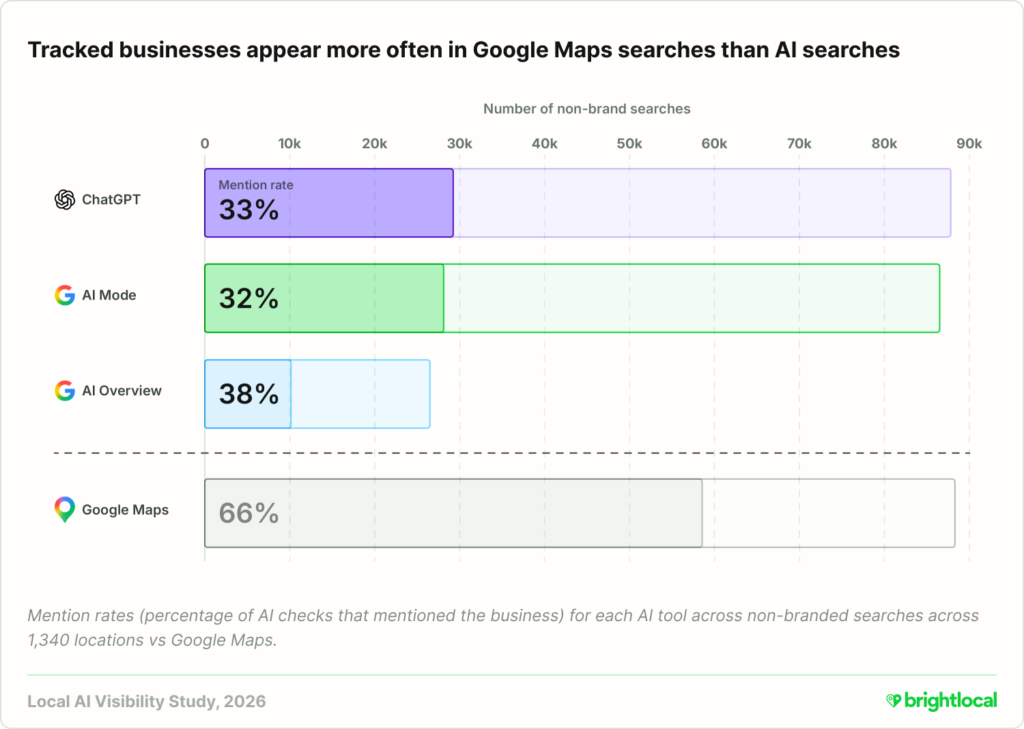
The Local Pack obviously uses a distinct local algorithm to choose a set of businesses to rank in it, while AI is curating a list based on the research it’s performed in its index. While many of the factors and sources will crossover, the AIs are performing multiple fan-out queries for each prompt, rather than one simpler keyword.
What is a fan-out query?
When an AI search engine answers a prompt, it does what’s known as a ‘fan-out query’. This means it:
1. Breaks down the initial prompt into multiple related questions or keywords
2. Performs a search for each of these individually
3. Brings all the answers together, assesses them for relevance, and returns a blend of answers
It does this fan-out to get as much context as possible, in an attempt to return the best answer.
A real-world example of this would be:
User enters a search prompt “best lawyer in downtown LA for family law”
The AI performs the performes searches for:
“best family law attorney Downtown Los Angeles divorce custody reviews”
“Los Angeles family law attorneys certified family law specialist downtown Los Angeles”
In some instances it will be more queries than this, in some it will be less.
This means that resting on your laurels is risky. Yes, you may be ranking well, with a local search grid ranking report full of green across your city, but that’s no guarantee that the AI platforms will choose your business.
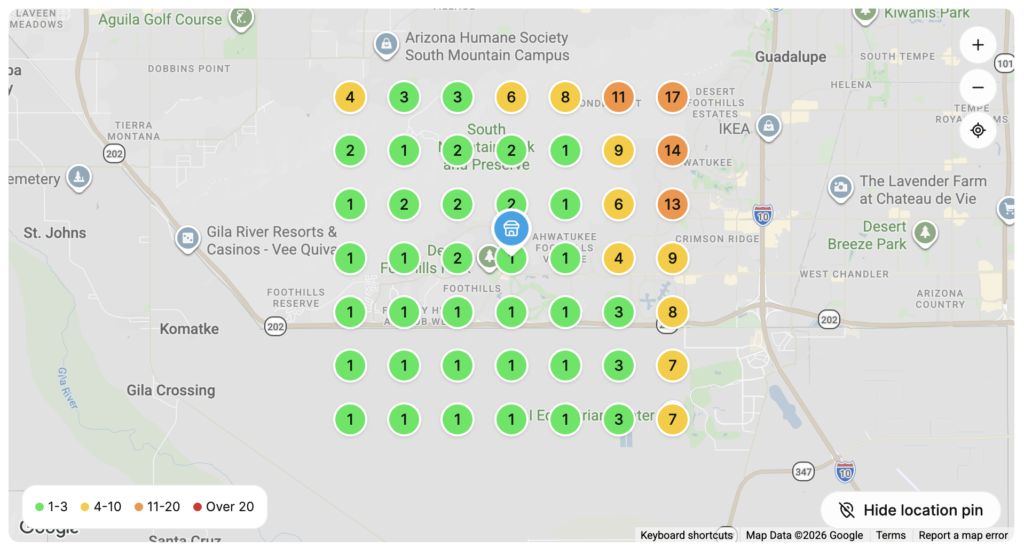
We’d recommend tracking both Google Maps rankings and local AI visibility.
The different platforms simply don’t agree. Even Google’s two AIs don’t have a huge crossover.
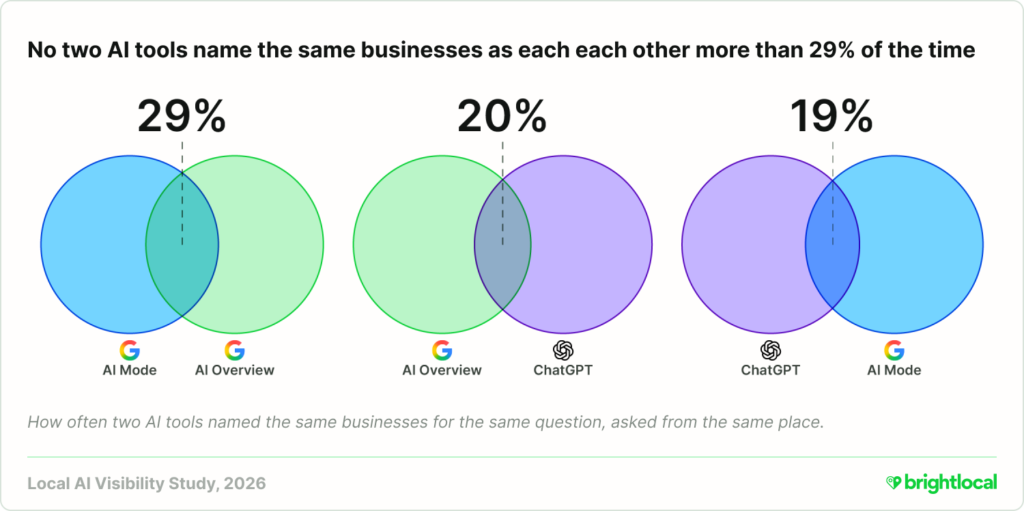
It’s not just an issue between Google Maps and AI. There’s a disconnect between each individual AI platform’s response for the same prompt.
Google’s AIO and AI Mode only share 29.3% of named businesses on average, and that’s despite both of them heavily relying on Google Business Profile as a source. Our research showed that Google Business Profile, in fact, made up 28.5% of all citations across all three platforms.
When you compare both Google AIs to ChatGPT, the difference is even starker, highlighting that ChatGPT’s relationships with Yelp and Bing mean it’s surfacing slightly different businesses. It had a crossover of just 20% with AIO and 19% with AI Mode.
While Google Business Profile is important for AI Mode and AIO, it’s hardly used by ChatGPT. All three platforms rely on Yelp, with Google relying on Facebook significantly too. ChatGPT’s different sources will explain why they crossover less with Google than you’d expect.
Full report: Where AIs get their local information
As with traditional local search, moving across a city changes the results, with ChatGPT the most volatile.
Overlap across different points in the same town: 36.2% (ChatGPT), 46.9% (AI Mode), 47.4% (AI Overview)
Only 3.5% of ChatGPT results are “always present” across points, vs 8.8% (AI Mode) and 25.0% (AI Overview)
Proximity: 52.8-59.3% of picks fall within 5km, 71.7-78.2% within 10km, but ChatGPT’s circle of influence (covering 90% of results) stretches to 287km vs 39-64km for the Google surfaces
Google’s local algorithm is well known for relying heavily on proximity, prominence, and relevance. The Local Pack is well known to change as you walk around a neighborhood. And you can see on a classic Local Search Grid, just how much rankings can change with distance from a business.
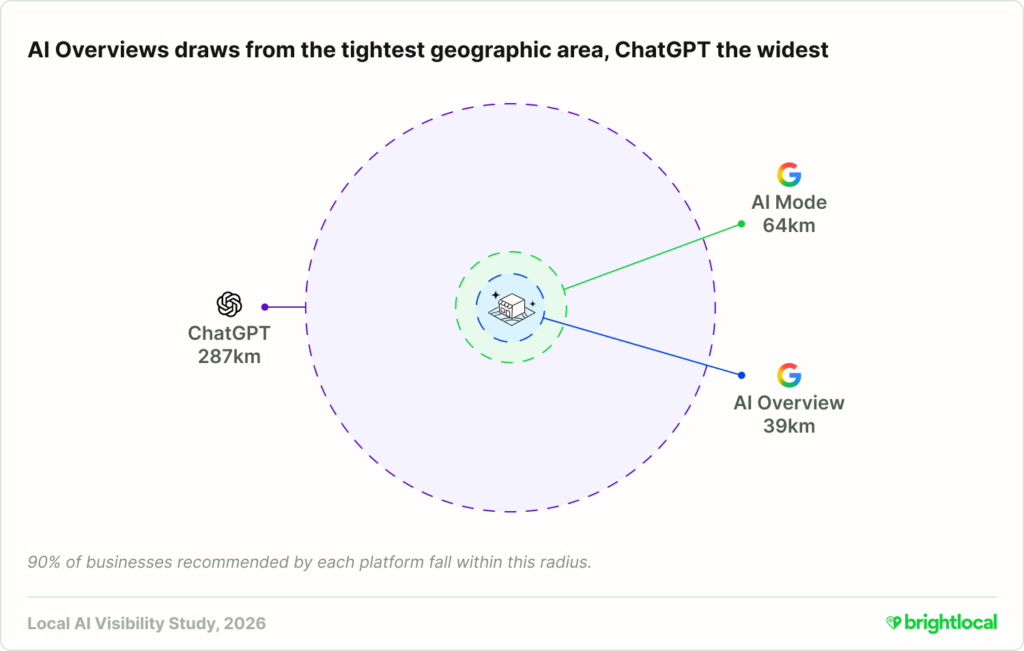
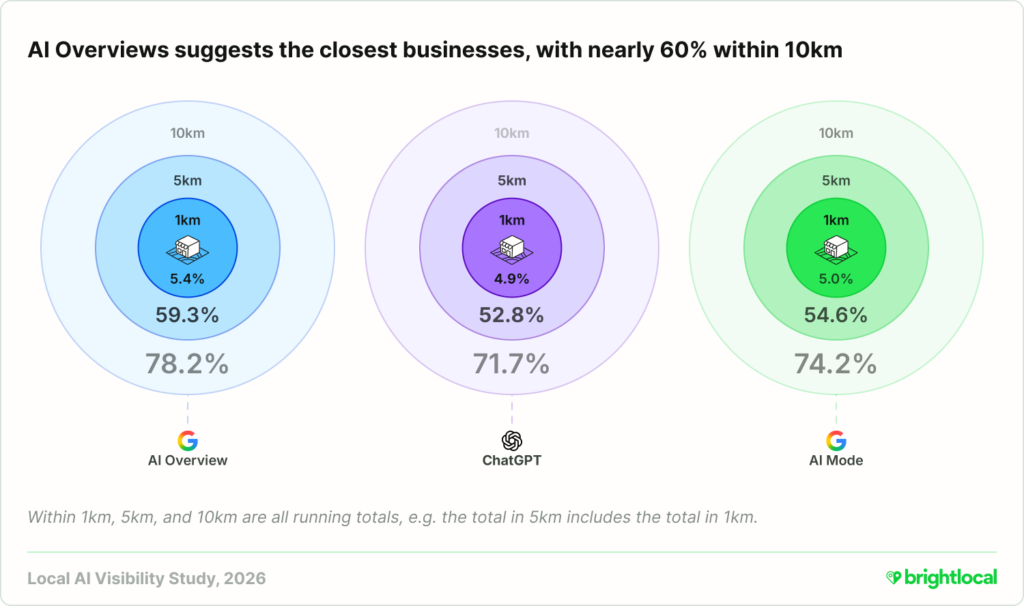
So we wanted to see whether AI platforms did the same. And they show that “near me” is still important.
Both AIO and AI Mode have quite tight radii, with approximately 5% of chosen businesses falling within 1km of the search. While ChatGPT starts close to this, as the distance increases, it starts to weaken. Just 53% of its chosen business recommendations are within 5km, compared to 53% for AI Mode and 59.3% for AIO.
Outside this radius, though, ChatGPT has both more recommendations and a wider net. Its circle of influence went up to 287km, compared to 64km for AI Mode and 38km for AIO. This is the radius that had 90% of the search results within it.
Moving across town and performing the same search also sees changes in what comes back. We ran each prompt 10 times across a map grid for each business. ChatGPT only had a 36% crossover when running the same prompt from different areas, while the Google platforms had closer to 50% (46.9% AI Mode and 47.4% AIO).
What this means for you
Near me is still alive and well, with proximity still being a key factor in local AI searches. Make sure you’re making your address easy to find on your website, and that your NAP (name, address, and phone number) is consistent across your off-site listings and mentions.
When you’re optimizing your website, make sure your location pages are clear and give good information for your specific locations.
Free resource: Location page checklist
Your website still matters. 93% of all unique domains used as sources were business sites, and they make up 42% of all citations.
Of 116,000 domains used as sources, 108,000 of them were ‘business websites’.
The number of individual citations that came from business sites was 42% of the 1,967,762 total citations
With AI search reducing traffic across the board (ahrefs study, and Define Media Group study), there’s been much debate about whether websites still matter.
As a content marketer writing a research piece that’s being published on a website, I may come across a little bias. But the data we’ve found in our research shows that, regardless of traffic, your website still matters for AI search.
Nearly all of the AI responses we analyzed used a website as a source about a business. Yes, there were plenty of third-party profiles on sites like Yelp, Tripadvisor, Facebook Business, and Google Business Profile, but your own website is still incredibly important for providing AI platforms with accurate information on your business.
Lily Ray, VP SEO & AI Search at Amsive, recently highlighted in her Substack that ChatGPT, in particular, has started using “site:” searches in its fan-out queries. This highlights both that AI already has an idea of who they want to recommend and that they want to get the information directly from that business’s website or related brand pages on third-party review sites.
What this means for you
Build yourself a website if you haven’t got one. And, if you do have one, make sure that it’s clear and easy for both people and AI to understand.
As we said above, your NAP and location pages need to be really simple and easy to get information from.
But you also need to have clear:
- Expertise. Make sure you showcase why you’re the best in your area.
- Reviews. Make sure you highlight why people love your business.
- Structure. Don’t overcomplicate it. Have obvious location pages and service pages, and answer common client questions.
See what questions are coming up in AI for your business and consider adding those as tracked prompts. Then answer those questions on your website. You can use Bing Webmaster Tools and Google Search Console to see what questions you’re getting impressions for in various AIs.
Tip: In Google Search Console, try a few of the following custom regex to discover potential AI prompts.
Open Search Console, then browse to performance.
Set the date range to 12 months.
Click ‘Add filter’
Select Query and change to ‘Custom (regex)’
Then use one of the following options:
See what conversational queries people are asking: ^(?:\S+\s+){9,}\S+$
See what ‘site’ searches are being performed for your business: (?i)(site:.*official|official.*site:)
Make it easy for customers to contact you via your website. With an agentic future, there’s a strong chance that bots will be filling in forms for your customers, too, so do what you can to prepare for that.
What else did we see?
There were a couple of other gems from our study that weren’t quite as significant, but we still wanted to surface them.
Directories still matter
Yup, you got it. In fact, this was actually part one of this same study. Just a couple of weeks ago, I did a deep dive into the sites and directories that AI platforms are using as sources.
We found that Google Business Profile was, by far, the most important source of information, especially on AI Mode and AIO. But beyond that, directories or listings like Yelp, Facebook, Mapquest, Better Business Bureau, and Angi are still important.
The top 10 for all three platforms is below:
| Domain | Citations | % of total citations | Businesses citing | % of total businesses |
|---|---|---|---|---|
| google.com (Google Business Profile) | 563,272 | 28.63 | 1276 | 94.17 |
| yelp.com | 187,599 | 9.53 | 1147 | 84.65 |
| facebook.com | 43,876 | 2.23 | 1261 | 93.06 |
| tripadvisor.com | 35,246 | 1.79 | 441 | 32.55 |
| opentable.com | 23,237 | 1.18 | 274 | 20.22 |
| mapquest.com | 8,282 | 0.42 | 741 | 54.69 |
| bbb.org | 6,519 | 0.33 | 397 | 29.30 |
| angieslist.com | 4,627 | 0.24 | 257 | 18.97 |
| reviews.birdeye.com | 3,612 | 0.18 | 343 | 25.31 |
| wanderlog.com | 2,694 | 0.14 | 268 | 19.78 |
AI platforms also use specific industry directories across different verticals. So making sure you’re listed on those is important.
You can see a much more detailed deep dive in the full local AI sources research.
Storefronts are mentioned more often than service-area businesses, but not by much
On average, storefront locations enjoy a 33.6% mention rate versus 29.4% for service-area businesses (SABs). This is a trend across all three platforms for storefront vs SAB:
| Storefront mention rate | Service area business mention rate | |
|---|---|---|
| ChatGPT | 33.7% | 29.4% |
| Google AI Mode | 31.9% | 27.4% |
| Google AI Overviews | 38.4% | 36.9% |
As ever, having a fixed public address makes it much more likely that you get recommended.
You can’t ignore AI, so start tracking now to see for yourself
AI is very much here to stay. There’s ever-present talk that Google will be making AI search the default for all searches. In early 2026, we found that 45% of consumers use ChatGPT or other generative AI tools for local business recommendations.
So what do you need to do about it?
First of all, you need to discover whether you’re one of the businesses in each AI platform’s pool of candidates. Our free Local AI Checker (which is coming soon) could be a good start if you’re after a single check.
But, as this study shows, you need to be looking at all three AI platforms and tracking them on an ongoing basis. Our Local AI Visibility Tracker, the one this study was based on, can help you do just that.
Actions
- Set up Local AI Visibility Tracking and check what competitors are coming up, and what they’re doing to be surfaced.
- Look at the sources AI is using for both your business and those of your competitors. Make sure you’re included in those same places.
- Build a website. It doesn’t have to be a complicated one. But you need to have your own space with clear information on who you are, where you are, what your expertise is, and how trustworthy you are.
- The good news is that most of the tactics that work for local SEO work for AI visibility too. So make sure you claim your Google Business Profile and start getting reviews across all relevant third-party sites.
Free resource: Free Local SEO Checklist
Methodology
We ran multiple reports (an average of 3) for 1,342 locations across 60 days. Each report included a set of prompts across nine map grid points.
We then analyzed the responses and mentions for 200,875 non-branded prompts. Branded prompts were left out of the findings so they didn’t skew results. Each check was localized for that business location.
We also analyzed 1.9million AI citations.