








Most small businesses are already working on getting found in AI search via Large Language Models (LLMs). In fact, we recently found that 65% say they’re on it, and 54% have checked and feel confident they show up. But are you putting your effort into the right places?
AI tools build their picture of your business from your Google Business Profile, your listings, your reviews, and your website, and those are exactly the places that tend to slip. Only 35% keep their Google Business Profile active, 41% keep their website active, and 26% are active on directories.
What is local AEO?
Local AEO (answer engine optimization), also referred to as GEO (generative engine optimization) means taking steps to ensure AI tools like ChatGPT, Google AI Mode, and AI Overviews can find accurate, consistent information about your business and feel confident recommending it when someone asks a localized question. For a local business, AEO is less about new tactics and more about keeping the sources AI reads complete and up to date.
In fact, many AEO tactics are very similar to the things you may already be doing for local SEO.
So, are you doing what counts? Here are 23 things to check off. If you’d like the full walkthrough, the free Academy course How to Get Your Business Recommended by AI Like ChatGPT and Google covers all of it, and our guide to AI local SEO explains the why behind each item.
How AI tools decide which local businesses to recommend
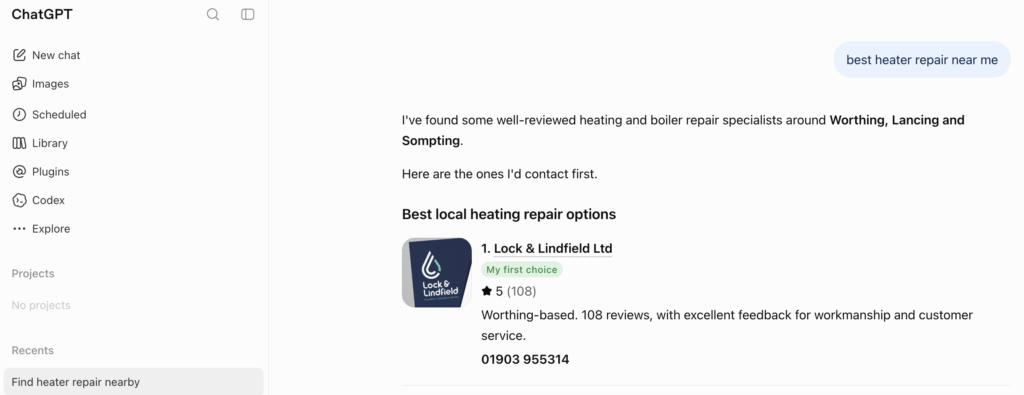
When someone asks ChatGPT for a plumber nearby, it pulls from sources it already trusts, assembles an answer, and moves on. Our Local AI Visibility Study analyzed 200,000 local prompts across ChatGPT, Google AI Mode, and AI Overviews, and found AI citing 415 different directories along the way.
The top five sources were Google Business Profile (28.6% of all citations), Yelp (9.5%), Facebook (2.2%), Tripadvisor (1.8%), and OpenTable (1.2%). Business websites made up 42% of citations on their own. So if this list looks a lot like local SEO, that’s because it is. AI tools read the same sources Google always has, and they reward the same consistency. The difference is that AI has fewer slots to fill. ChatGPT names around four businesses per answer, and AI Overviews fewer than three, so there’s less room to be almost right.
Download the AEO Checklist
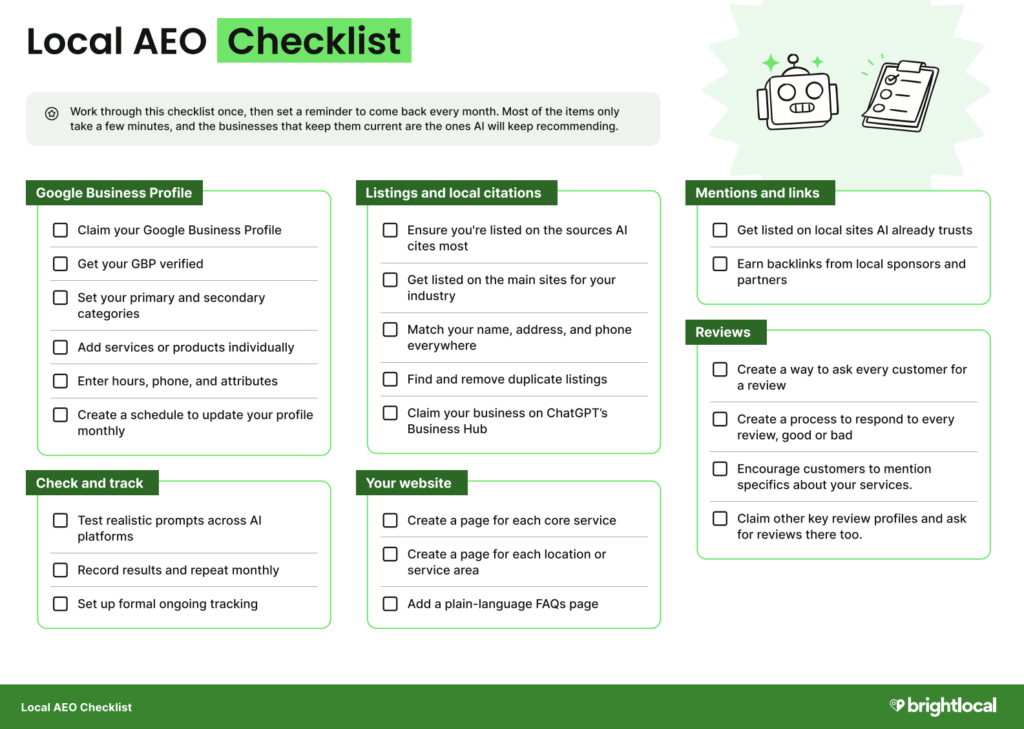
Click on the image of the local AEO checklist below for a PDF version.
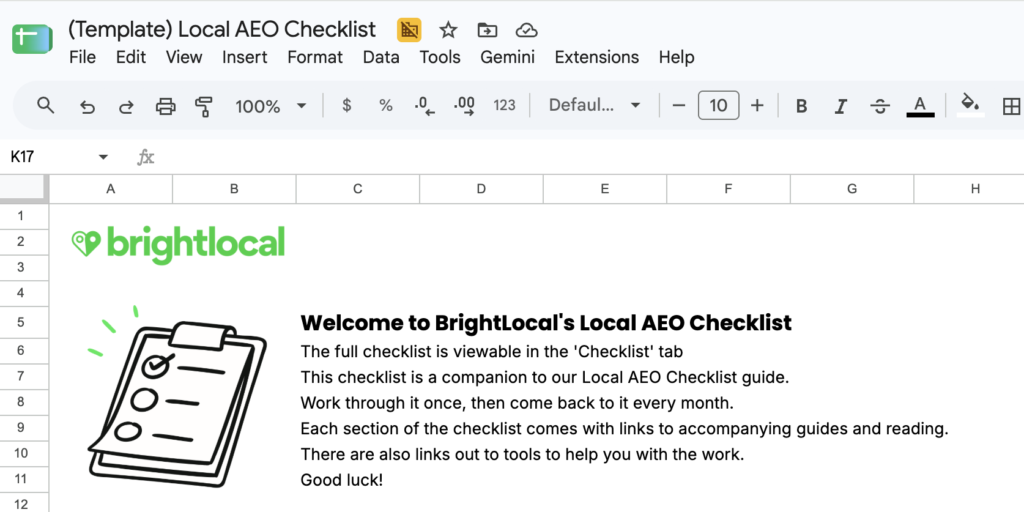
If you prefer to work in Sheets, you can download a copy of our Local AEO Checklist master template. Follow the link below where you can ‘make a copy’ of the sheet.
Work through it once, then set a reminder to come back every month. Most of the items only take a few minutes, and the businesses that keep them current are the ones AI will keep recommending.
Google Business Profile (items 1 to 6)
According to our research, 85% of small businesses have a Google Business Profile (GBP), which is great because it’s the source that AI cites the most. However, in that same research, we found that only 35% keep it active, so it’s also the one that most owners let slide.
1. Claim your Google Business Profile. If you haven’t claimed it, Google often creates an automatic listing using third-party data scraped from across the web. That unmanaged profile is a blank canvas for incorrect information, competitor edits, and outdated details that AI tools scrape and report as fact. Claiming your Google Business Profile is the only way to ensure search engines and AI tools present your business accurately.
2. Get your GBP verified as soon as possible. Unverified profiles can’t be fully edited and are far more likely to show stale or incorrect details, which AI then repeats. Learn how to verify your GBP here.
3. Ensure your primary category is right, and your secondary categories are complete. Categories are how Google (and the AI tools reading it) decide which searches you’re relevant for.
4. Add your services or products individually. Adding”Emergency plumbing” as a named service on your profile, for instance, gives AI something specific to match against a specific question.
5. Enter your hours, phone number, and attributes correctly. Prompts like “open now” and “wheelchair accessible” are answered straight from these fields.
6. Create a schedule to make sure you update your profile monthly. A new post, photo, or Q&A answer signals the business is active, which matters when AI is choosing between you and a competitor.
Listings and local citations (items 7 to 10)
Only 26% of small businesses are active on directories, yet directories are where ChatGPT, in particular, does most of its reading. Yelp shows up in 80% of ChatGPT’s local answers. Being absent from a source AI leans on is the quickest way to be left out.
7. Ensure you’re listed on the sources AI cites most. That means Google Business Profile, Yelp, and Facebook for everyone, plus Tripadvisor or OpenTable if you’re in hospitality.
8. Get listed on the main sites for your industry. A roofer needs Angi and the BBB. A dentist needs Healthgrades. Our top citation sites by industry list tells you which ones apply to you.
9. Make sure your name, address, and phone number match everywhere. Even small differences (“Suite 4” versus “#4”) make AI less sure it’s the same business, and less likely to recommend it.
10. Find and remove duplicate listings. Two Yelp pages for one business split your reviews, giving AI two conflicting versions to choose from. Find out how to handle duplicate listings and data inaccuracy.
11. Claim your business on ChatGPT’s Business Hub. It’s ChatGPT’s own version of Google Business Profile, so what you add there shapes how ChatGPT describes and recommends you. For now, only local stores and restaurants with an existing US listing can claim one. For more information see our guide.
For the full list of 415 directories AI has been seen citing, see where to get local citations for AI search. If building and fixing listings by hand isn’t how you want to spend your time, our Citation Builder service does it for you.
Need help building citations?
Reviews (items 11 to 14)
Reviews are how AI learns what your business is really like, beyond what you share on your site. Plus, your customers rely on them every day, and many of them are reading your reviews within AI tools
Right now, our research says there’s a big gap between what your customers hope for and what businesses actually offer.
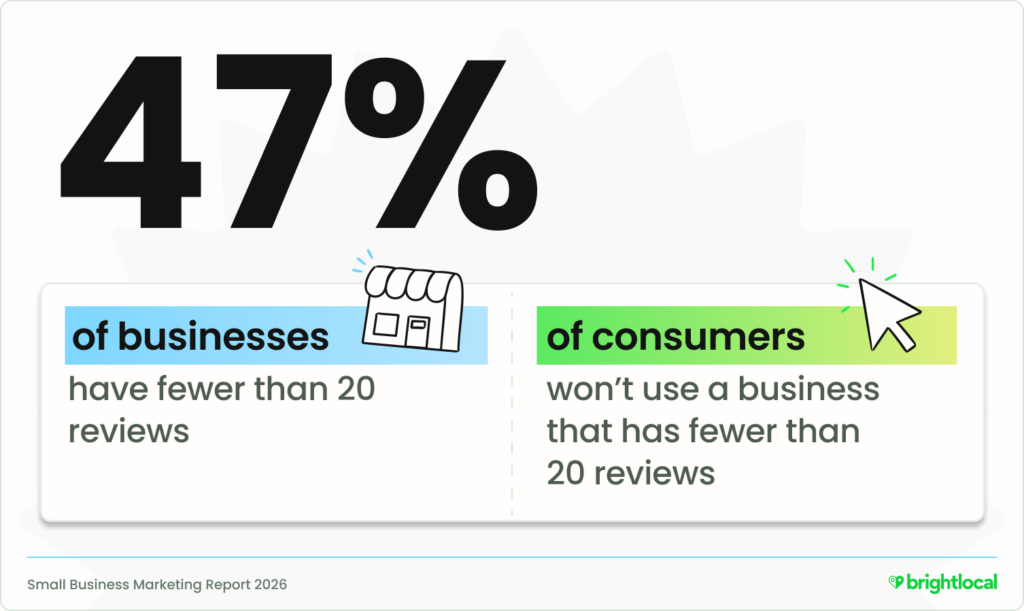
Here is how you can easily care for your reviews so AI tools give your business the spotlight it deserves:
12. Create a way to ask every customer for a review so you get new reviews every month. AI tools favor recent signals, so a steady trickle beats a burst from two years ago. Ask every customer, and make it as quick and easy as possible.
13. Create a process for responding to every review, good and bad. A reply shows an active, accountable business, and it gives AI more text about you to read. You can even use response templates.
14. Encourage customers to mention specifics about your services. AI likes your reviews that mention your services and your area. Such as, “Great emergency plumber in Park Slope”. You can’t write your reviews, but you can prompt customers to say what they had done and where in theirs.
15. Claim other key review profiles and ask for reviews there too. ChatGPT reads Yelp; Google reads Google, and those aren’t the only places. If all your reviews live in one place, the other platform can’t see them. Check out our list of review sites by industry to find the right platforms for your business.
The free Academy course A Beginner’s Guide to Generating and Managing Reviews covers how to ask, how to respond, and how to keep it going without it taking over your week.
Your website (items 14 to 17)
Taken together, business websites made up 42% of all citations in our study, more than any single source. Your own site is a small slice of that, but it’s the slice you control. Even so, only 41% of local businesses keep their sites actively updated. Luckily, focusing on just three key pages can make a world of difference.
16. Ensure you have a page for each core service. AI matches questions to pages. One “Services” page listing everything gives it nothing specific to cite for “water heater repair,” so make sure each service page has FAQs about that service.
17. Create a page for each location or service area. If you serve three towns, name them. AI tools pull location data from your content, and ChatGPT in particular will recommend businesses a long way off if nothing closer says it’s local. Check out our guide on how to create unique and helpful location pages with a free checklist.
18. Add a plain-language FAQs page. Write the questions the way customers ask them, and answer in two or three sentences each. This is the format AI lifts from most readily. While you’re there, add LocalBusiness schema to the page. It’s good structured-data practice, though it doesn’t directly change what AI says about you. Our free course on How to Use Local Schema to Help You Get Found shows you how in under an hour. Or check out these local schema templates.
Mentions and links (items 18 to 19)
AI tools trust sources that already have a reputation, and in your town that means the chamber of commerce, the local paper, community organizations, and your industry association. The goal is to be talked about in the places AI reads.
19. Get your business listed on local sites AI already trusts. A chamber of commerce listing, a sponsor credit on a youth league site, or a mention in local press all help AI connect your name to your area.
20. Earn backlinks from local sponsors, suppliers, and community partners. You don’t need hundreds of links. Ask existing partners, vendors you work with, or local events you sponsor to feature a link to your website, showing AI and Google that reputable local organizations vouch for you.
Local link-building can take time, and isn’t necessarily a quick task. Our free course How to Master Local Link Building covers how to earn these without cold-emailing strangers.
Check and track (items 20 to 23)
46% of small businesses haven’t checked whether they appear in AI search, or don’t know. Checking takes 10 minutes and tells you which of the 18 items above to work on first.
21. Test realistic prompts across ChatGPT, AI Mode, and AI Overviews. Use a private browsing window or logged-out session without search history so your previous activity doesn’t skew the results. Test prompts like “emergency dentist open late in Brooklyn tonight” rather than generic searches, and run them across all three platforms.
22. Record the results and repeat the test monthly. AI answers change from run to run. Across the 200,000 prompts in our study, repeating the same prompt returned the same businesses only 20% to 33% of the time. One check tells you very little, but regular checks over time tell you a lot.
23. Set up formal ongoing tracking after initial self-checks. Manual checks are great for getting started, but moving to an automated tracking workflow ensures consistent reporting as AI search results evolve.
If you’d rather not do this by hand, our Local AI Visibility Tracker runs your prompts across all three platforms and tracks the results over time. Or check out our free Local AI Visibility Checker.
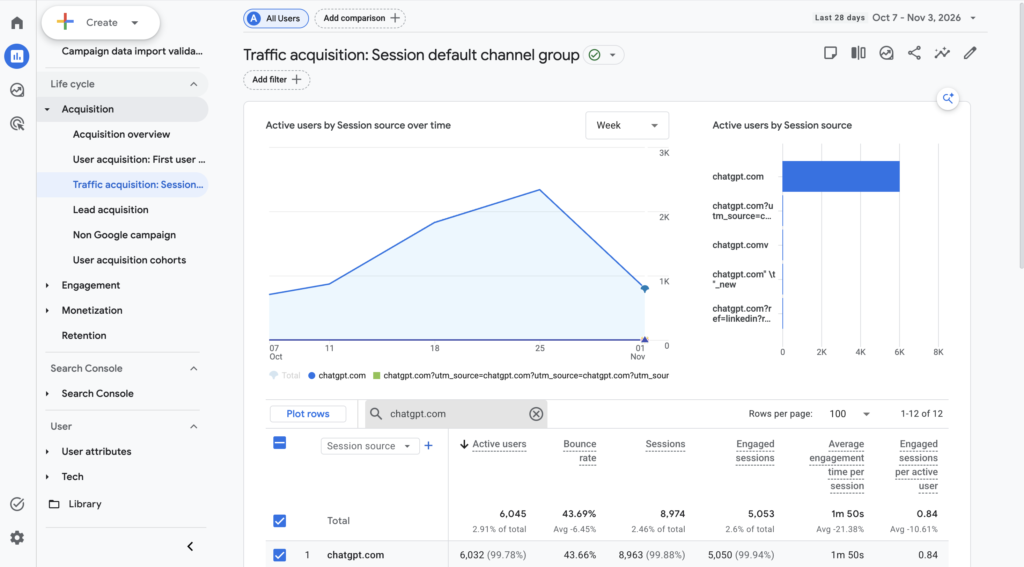
A quick note on GA4. If you have Google Analytics 4 set up for your site, you can see whether AI tools are already sending you visitors.
- Open Google Analytics 4.
- Go to Reports, then Acquisition, then Traffic acquisition.
- Next, search the source list for chatgpt.com, perplexity.ai, copilot.microsoft.com, and gemini.google.com.
Google AI Mode and AI Overviews traffic still shows as Google organic, so you won’t be able to separate it out there.
Is your business being recommended by AI?
What you can skip (for now)
Most AEO checklists are written for enterprise or B2B sites, and they’ll happily keep you busy with things that don’t move the needle for a small local business. You can safely leave these alone until the 20 items above are done.
- Sprawling schema. LocalBusiness schema on your key pages is plenty. You don’t need FAQPage, Speakable, and six nested types.
- Chasing every new AI platform. ChatGPT, AI Mode, and AI Overviews cover the vast majority of local AI searches. Perplexity and the rest can wait.
- “AI content” for its own sake. A 2,000-word blog post written to impress a language model won’t beat a clear service page written for a customer. The same can be said for using it to produce hundreds of content pieces.
- “Chunking” and content restructuring. Short paragraphs and clear headings are good practice. Rebuilding your site around how models tokenize text is not a weekend job worth doing.
- llms.txt. Harmless, unproven, optional. Add it if you like, then forget about it.
Putting AEO into Practice
Optimizing for AI search doesn’t require reinventing your digital marketing strategy. By keeping your Google Business Profile active, ensuring consistent citations, actively managing customer reviews, and organizing your website content clearly, you build a foundation that both traditional search engines and modern AI tools trust. Work through these checklist items systematically, set up regular tracking, and utilize BrightLocal’s Local SEO Services to maintain your competitive edge in local AI search recommendations.