









Ben Fisher, founder of Steady Demand, has spent nearly 30 years in the search industry and was one of the first three Google Diamond Product Experts in the US. He joined BrightLocal’s CEO and co-founder, Myles Anderson, for a chat about AI. Everything he talked about didn’t start with a tool, but with a clear problem that needed solving.
This story is part of our practical series exploring how local SEO professionals use AI in their day-to-day work. It follows our helpful conversations with Noah Learner at Sterling Sky, Dana DiTomaso at Kick Point, and Mike Forgie, a local search and AI optimization expert. While Noah and Dana shared deep insights into reporting, and Mike walked us through streamlining agency workflows with Claude Code, Ben offers a unique perspective: using AI to publish original research that anyone in our community can verify and build upon.
Ben’s approach to technology always returns to a simple, guiding principle:
“Everything starts with a problem. Whether that problem is saving yourself 15 minutes with a repetitive task, or trying to figure out something complex.”
Solving the “150-location challenge”
One of Ben’s customers is a large enterprise that believed it had 150 locations, although it wasn’t actually sure.
To help them, Ben used AI to create a scraper that ran a match against a list of business names, consolidated the data, and built a user-friendly tracking app so the customer could easily follow the progress.
It was a custom solution meant for a single task, and he knew it would be retired once complete.
“To build an app like that back in the day would have taken a developer weeks, months maybe, and a cost that would be sunk into that. And you can get the entire thing done in an hour and a half.”
Creating custom software used to be too resource-intensive for temporary needs. But today, building a quick tool to solve a specific client challenge in an afternoon is well worth the effort.
Audit your time, and break down annoying tasks before jumping to optimizing them
Like many of us, Ben spent a lot of time in his inbox, while his team’s client data lived in internal dashboards. Switching back and forth was taking up valuable time, so he decided to measure the exact impact.
“I found out after I was tracking it that I was wasting probably north of two hours a day going back and forth between the portal and email.”
By using AI to bring the dashboard data directly into Gmail, he saved about an hour and a half every day.
The habit of measuring first is something we can all learn from. While we often feel that certain routines are inefficient, taking a moment to gather clear numbers first helps us make thoughtful, effective improvements.
Create somewhere to keep the tools you build
Ben shared a common hurdle that comes with building many solutions:
“You start forgetting things after you start building 10, 20, 30 different types of applications.”
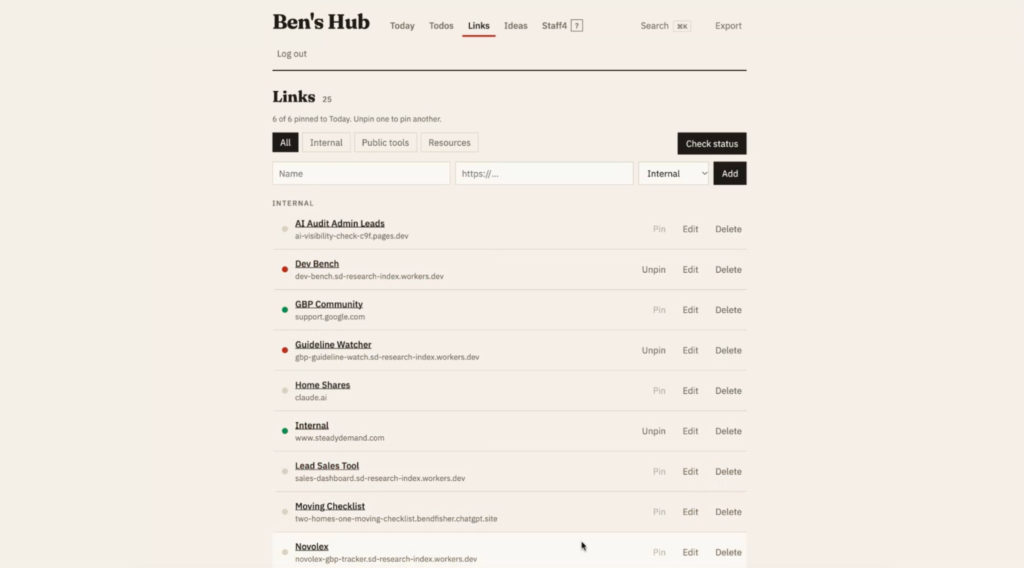
His solution was to create a personal central hub. It neatly holds his to-do list, helpful links, daily schedule, and every tool he’s built, helping keep everything organized as his needs evolve.
AI has helped him do the research that he’s always wanted to do
For years, Ben wanted to share original research with the local SEO community, but he hesitated for a reason many of us can relate to:
“I’ve always wanted to do studies, but I’ve always hated doing the math and doing the research.”
With AI, that heavy lifting is simplified, unlocking endless possibilities.
“I ended up literally coming up with way too many stats to digest. These are all the stats that have come out of just the past 30, 40 days.”
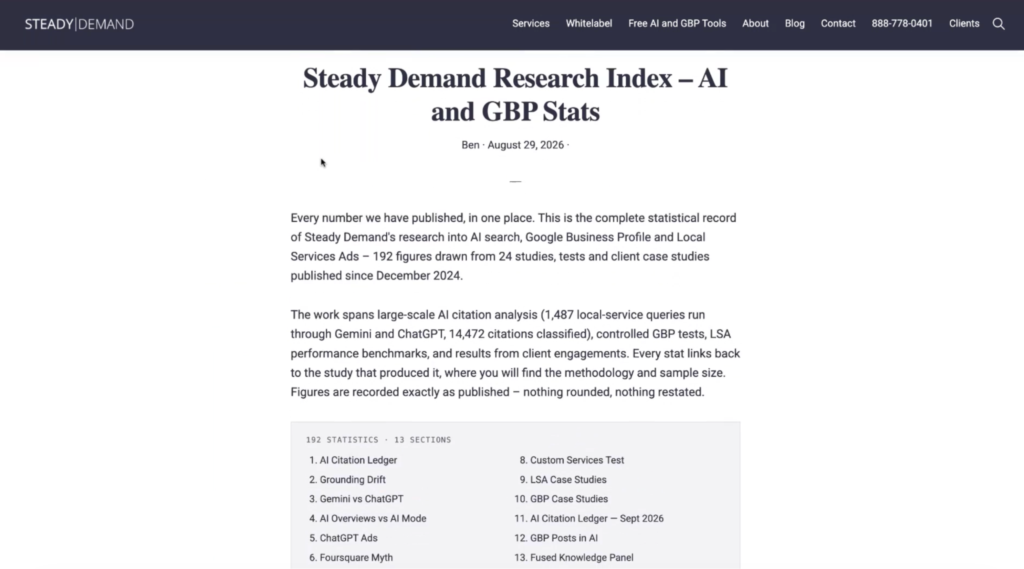
To manage all this new information smoothly, he designed a supportive social media system that drafts posts and keeps track of what’s ready to share.
Keep control of the process, but let the AI do the heavy lifting
Ben offered a truly valuable lesson for all of us using AI in research. He deliberately chooses to guide the process personally, rather than handing over full control.
“I’ve been able to do the studies more like an academic researcher. So, not letting Claude do all the work. Do the heavy lifting, yes.”
He sets the direction and first outlines the research framework. AI assists with tasks like connecting APIs, gathering data, and working through numbers. Afterward, Ben carefully refines the findings into a clear, natural voice that readers can easily connect with.
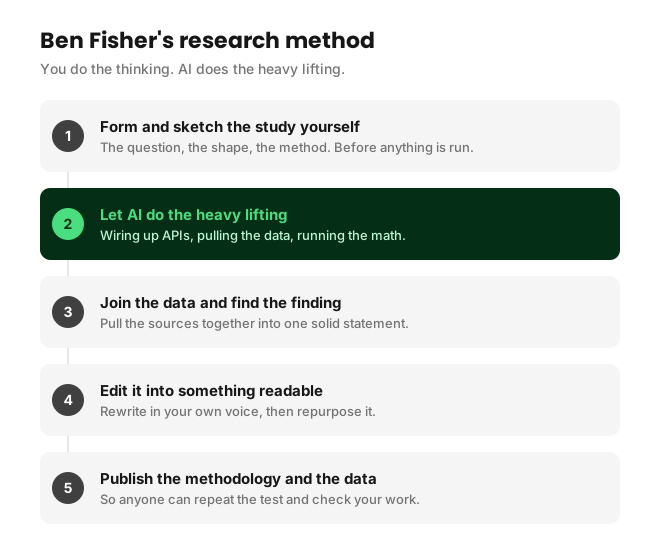
Publish the methodology
Ben highlights that being as open as possible about the methodology and the data is important to build trust.
“More importantly, releasing the methodology and the data behind it, so anybody can repeat those tests. And I don’t see a lot of people in this industry doing that.”
Transparent methodology is key to building trust. Because AI search results and citations evolve over time, sharing open data enables everyone to test and confirm findings together, ensuring our industry moves forward with reliable insights.
This open approach brings great benefits. Internally, his team makes confident, data-backed decisions. Externally, sharing detailed research helps smaller agencies build authority and guide others effectively.
Start something, and break it
Ben participates in an AI peer group where members share learning experiences. He warmly shares that he was initially hesitant himself before diving in.
“I was scared of it, I was hesitant.”
After gaining hands-on experience with tools like Claude Code, he offers these simple, practical steps to help ease into the technology safely:
- If security is a worry, work on a separate laptop
- If it’s a serious worry, put that machine behind a VPN
- Get your team learning to prompt, because that skill isn’t optional for much longer
From there, the best way to learn is simply to begin experimenting with small projects.
“You’re not a programmer? Well, guess what, now you can be. Build a clone of Asteroids? Go ahead and do it. Just do it. Do it and break it.”
The goal isn’t perfection right away; it’s gaining confidence through hands-on practice, building useful skills that directly help you support your clients better.
“It empowers anybody who’s willing to try it. If you have an idea, and if you can do a little bit of troubleshooting, you can get up really far.”