



Welcome to our annual look ahead! This year, our experts agree on one big thing: Local SEO in 2026 isn’t about optimizing for Google; it’s about being a genuinely great business.
The big changes we saw bubbling up in 2025—things like super-smart AI and how customers actually find places—are now the new normal. The message is clear: the customer experience is the new algorithm. Stop focusing so much on old, technical SEO tricks and start focusing on creating moments that people love and want to talk about online.
Success next year belongs to the businesses that inspire organic chatter on social media and community sites, platforms that the search engines and new AI tools actually trust.
2026 Predictions at a Glance
-
Myles Anderson: Focus on Google’s live data first, but ensure your site is “agent-ready,” so AI tools can easily help customers book and buy.
-
Rachel Ellen: Think of local presence as hospitality, create real-world experiences that people naturally want to talk about.
-
Crystal Carter: Prepare for the “agentic web” by making your site’s functions accessible to AI assistants.
-
Claudia Tomina: Success will come to those who make it easy for AI to turn a customer’s discovery into an instant action.
-
Steve Wiideman: Real customer sentiment and reputation are becoming more important than simple keyword matching.
-
Will Scott: Helpful comparison guides and “Top X” lists are the best way to earn a spot in AI search results.
-
Stefan Lozo: As AI results begin to feature ads, a mix of paid channels and Digital PR will help maintain your reach.
-
Andrew Optimisey: Expect Google to introduce more AI features—like Gemini calling to check stock—to make local search more interactive.
Ready to see what the experts are predicting? Let’s dive in.
Myles Anderson on Gaining Confidence and Taking Action

"Your local marketing strategy for 2026 and beyond should prioritize Google first, and LLMs second."
Co-founder and CEO at BrightLocal
If 2025 was about reacting to the unknown, 2026 is about gaining confidence and taking action. We’ve realized something quite reassuring: the fundamentals of good, long-term SEO strategy, based on the goals of building trust and authority, are still the backbone of earning visibility.
My predictions for 2026:
-
Google first, LLMs second: Google owns the live data of the physical world. Your primary strategy should still center on Google, while treating LLMs as a secondary (but growing) discovery layer.
-
Websites must become transactional: We are moving into an era where AI agents (like those powered by Gemini and ChatGPT) are visiting your site to take action. Ensure your booking forms and stock levels are “agent-friendly.”
-
Reputation everywhere: To earn trust in the AI era, you must build a strong reputation on a wider set of platforms, such as Yelp and industry-specific sites, which serve as vital data sources for LLMs.
-
The agency pivot: Successful agencies will shift toward measuring “share of voice” and focusing on customer retention, helping clients turn their existing base into lifelong advocates.
-
The Reddit evolution: As Reddit becomes a key source of “authentic insight” for AI, focus on genuine community participation rather than low-quality, automated spam.
Read Myles’ full deep-dive on the future of local search on LinkedIn here.
Rachel Ellen on a Strong Local Presence

"Strong local presence won’t just mean being found; it will mean being remembered, recommended, and revisited."
Local Search Strategist at Croud
In 2026, local marketing will be less about “find a store near me” and more about “where can I go that’s actually worth showing up for?”
Consumers will always check for the basics, such as opening hours and phone numbers, but they also want to be inspired and given real reasons to visit. The spark often starts somewhere completely off-platform: a TikTok video showing a new drop happening only in one store, a Reddit thread sharing honest experiences, or a niche community recommending a location because something is happening there. Brands that turn stores and spaces into places worth talking about, through events, experiences, exclusives, or simply great local culture, will outperform those relying on templated landing pages and generic copy.
And crucially, this shift will make local marketing much more exciting and collaborative! Store staff, creators, local communities, loyalty teams, and customers will become contributors, not just recipients. Local will expand beyond “visibility” into something closer to hospitality and enthusiasm-building. Strong local presence won’t just mean being found; it will mean being remembered, recommended, and revisited. The brands that embrace this will see that community-powered experiences create measurable demand online, higher conversion offline, and a genuine reason for customers to turn up in person rather than scrolling past. I, for one, am super excited for the strategic evolution that we’ll need to embrace!
Crystal Carter on AI Agents

"If your forms, checkouts, appointment scheduling, and restaurant bookings are not accessible by AI agents, you won’t even be in the game."
Head of AI Search and SEO Communications at WIX STUDIO
I expect the agentic web to hit its stride in 2026. In case you haven’t noticed, agentic use of AI is ramping up. Google launched its Agent to Agent Protocol, OpenAI launched its Agentic Commerce Protocol, and Google also dropped the Agentic Payments Protocol, all in 2025. And they are just getting started.
At Wix, we’ve configured our website builder with the Agentic Commerce Protocol because automated shopping from AI tools will be a game-changer for users. We understand that for site owners, it means it’s not enough just to be mentioned in Google, ChatGPT, and the like; you need to build your website to become a tool for autonomous AI use via agents. If your forms, checkouts, appointment scheduling, and restaurant bookings are not accessible by AI agents, you won’t even be in the game.
Claudia Tomina on Agentic Workflows

"Visibility will depend on how well a business supports AI-assisted actions and transactions."
Founder at ReputationArm
Agentic workflows will become far more visible, moving users from discovery to action with fewer steps in between. Rankings alone won’t carry the weight they once did. Visibility will depend on how well a business supports AI-assisted actions and transactions.
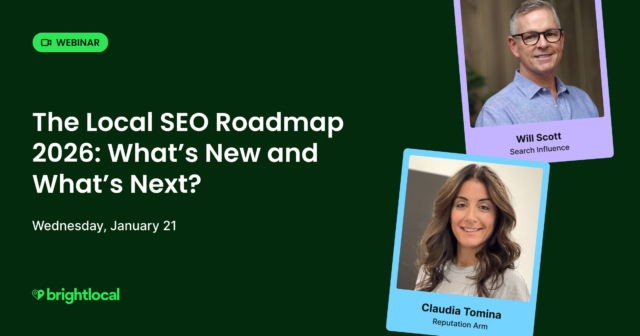
Claudia will be diving deeper into these predictions in our upcoming webinar, The Local SEO Roadmap 2026: What’s New and What’s Next?
Steve Wiideman on the Shift from Keywords to Context

"You can spend a month attempting to spam the web... or be the business customers are raving about, thereby allowing them to do all the LLM SEO work for you."
Owner at Wiideman Consulting Group
In the realm of multi-location SEO, platforms like ChatGPT, Perplexity, and Gemini pay attention to focal points we already include in modern optimization: consistent business data and important passages within location or intent pages.
Most importantly, reputation takes precedence in local intent answers… We see reputation and sentiment used to solve for prompts like “highly-rated” or “top-rated,” while personalization eventually removes the need for these modifiers.
Four Key Focus Areas for 2026:
-
AI-Powered Data Management: Leveraging AI to research, discover, and update business data.
-
Powering LSEO with Vectors: Semantic vectors will reward listings that offer rich, contextually relevant, and entity-based information rather than just keyword matches.
-
Smarter Location & Intent Pages: Moving away from 2019-style templates toward AI-driven, data-rich landing pages that are more helpful than ever.
-
Convergence of Citations & Reputation: Moving past traditional “NAP” data entry toward authentic marketing on destinations visited by real people (Reddit, Yelp, TikTok) to foster visibility.
Final Thought
You can spend a month attempting to spam the web… or be the business customers are raving about, thereby allowing them to do all the LLM SEO work for you.
Will Scott on Comparison Content

"The data is clear: even self-referencing top X and comparison content is winning in AI."
Co-founder and CEO at Search Influence
We’ve been spoiled in local SEO as Google AI Overviews have left us alone so far. That’s about to change, big time. If you’re not already on the hunt for “best of [your category and city]” and “top X” lists, it’s time to get going. And if nobody else is writing them? Write them yourself. The data is clear: even self-referencing top X and comparison content is winning in AI.
Stefan Lozo on Monetizing AI

"LLM companies will try to monetize AI results..."
Founder and SEO Consultant at Lozo Digital
Businesses and bad agencies will try to use AI aggressively for quick and fast results. This will create a lot of mess, and a good SEO expert will have a lot of work to do and clean up the mess. For success, SEO alone won’t be enough, so there will be more demand for paid channels and digital PR, and their prices will increase. LLM companies will try to monetize AI results with some ad formats. SEO will definitely continue to evolve and continue to be a strategic part of the marketing strategy.
Andrew Optimisey on AI Features
"AI-geddon is coming!"
SEO Consultant and Owner at Optimisey
Google is going to push more and more AI features into local. They have to, they’ve invested so heavily in AI now it has to earn its corn:
- AI overviews in Maps +++
- “Use Gemini to book” buttons where AI calls businesses for you
- “Check stock with Gemini” ditto
- AI summaries of reviews, services, and service pages
- Web Guide style Map Packs with it split in sections, e.g., for restaurants: “Pet-friendly restaurants”, “Highest reviewed restaurants”, “Menu highlights”, etc.
AI-geddon is coming!
Key Takeaways: Your 2026 Local Marketing Action Plan
The roadmap for 2026 is clear: the era of “gaming the system” is over. To win, you must stop focusing solely on technical loopholes and start focusing on becoming a pillar of your community—the kind of business people mention by name without needing a search engine.
Here is how you can guide your business toward success in the local landscape this year:
-
Be worth talking about: Search engines now prioritize “social chatter” and real human recommendations. Don’t just exist; create experiences, events, and a culture that people want to share on TikTok, Reddit, and in their own local circles.
-
Build an “agent-ready” website: AI agents (like those powered by Gemini and ChatGPT) are increasingly handling the “doing” for your customers. If your website doesn’t have structured, easy-to-read forms for booking, scheduling, or checking stock, these AI tools will skip you in favor of a competitor who is more “agent-friendly.”
-
Prioritize Google, but feed the LLMs: Google remains the king of live local data, but AI models like ChatGPT can’t see Google reviews. To be found everywhere, you must build a 5-star reputation on diverse platforms like Yelp, TripAdvisor, and industry-specific directories.
-
Content must be actionable and opinionated: Generic landing pages are no longer enough. 2026 rewards “comparison content” (e.g., The Top 5 Coffee Shops in London) and raw, authentic human writing. Don’t be afraid to show some personality; the “messy” truth beats AI-generated fluff every time.
-
Shift your definition of success: Visibility is the new gold. As organic clicks become harder to track, focus on your “share of voice.” If people see your brand mentioned across multiple platforms—even if they don’t click a link immediately—you are winning the long game.
-
The fundamentals still rule: At its core, SEO is still about trust and authority. While the tools have changed, the goal hasn’t: be the most reliable, highly recommended business in your neighborhood, and the algorithms will naturally follow your lead.

Contents

