







Key findings
-
Google deserves more attention: Most consumers used it during their most recent local business search, yet business owners don’t think it leads to many new customers
-
Marketing effort doesn’t match consumer behavior: Owners prioritize social media, while consumers keep coming back to Google
-
Google Business Profiles are common, but underused: Most businesses now have a profile but many aren’t keeping it up to date
Ask a small business owner where their customers come from, and they’ll probably tell you they get a lot of word-of-mouth recommendations. Others may say that social media brings in most of their new business. Many may have no real idea at all.
But if you were to ask consumers how they found a business? It may be a different story altogether.
Earlier this year, we followed consumers through their most recent local business search. Most made decisions quickly, stayed close to Google, and checked AI recommendations against other channels.
Now we’re looking at the other side of the search: what small business owners are doing about marketing. We asked 1,000 US small business owners of companies with 1-50 employees to share their marketing secrets to help us understand if small business marketing matches what consumers really need.
Here, all eyes are on Google. Is it still the top channel? Are small businesses making the most of it? And if businesses aren’t showing up where consumers are looking, could they be invisible to their next customer?
Where do small businesses get customers? It isn’t where they think.
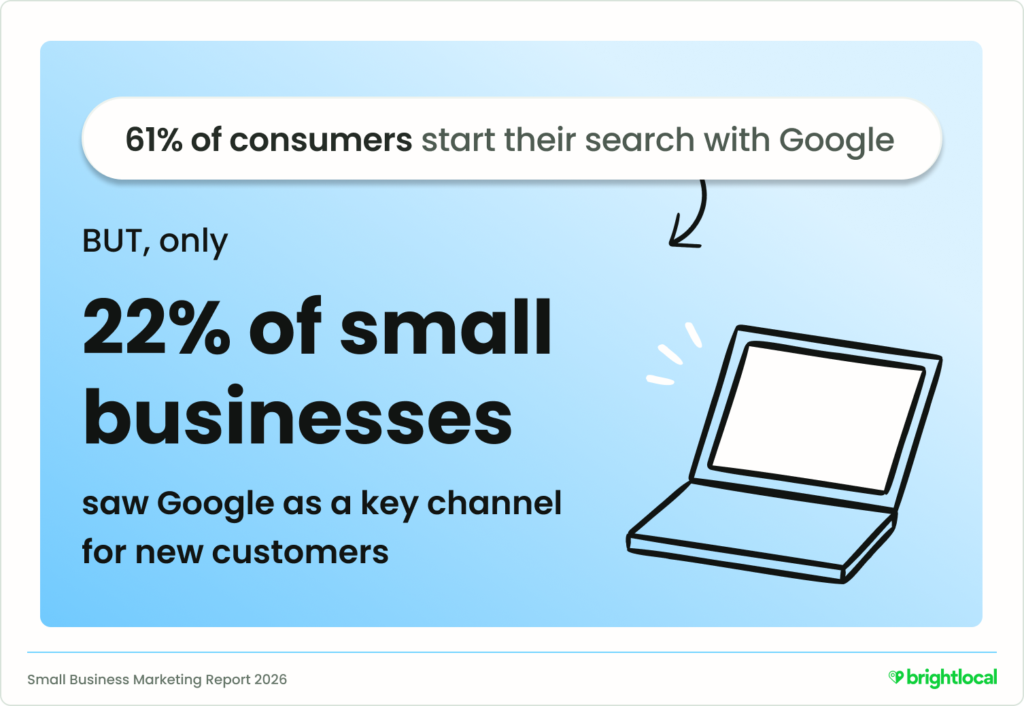
Small business owners were asked to share the two channels they believe delivered the most new customers in the last 12 months. The channels that came out on top were:
- Word of mouth (35%)
- Social media (33%)
- AI tools (23%)
- Direct from the business website (22%)
- Google (22%)
A positive recommendation from a friend or family member can go a long way. Social media works in many ways too, whether consumers are looking on your own page for information or asking in community groups or in posts for a recommendation.
Of course, hearing about a business doesn’t always lead directly to a purchase. Someone might spend time comparing their options by looking at multiple channels, or remember a recommendation from years ago when they finally need that service. Where they finally contacted you may be only one part of a far longer journey.
What stood out to us here, though, was where Google placed.
Google matters more than businesses think
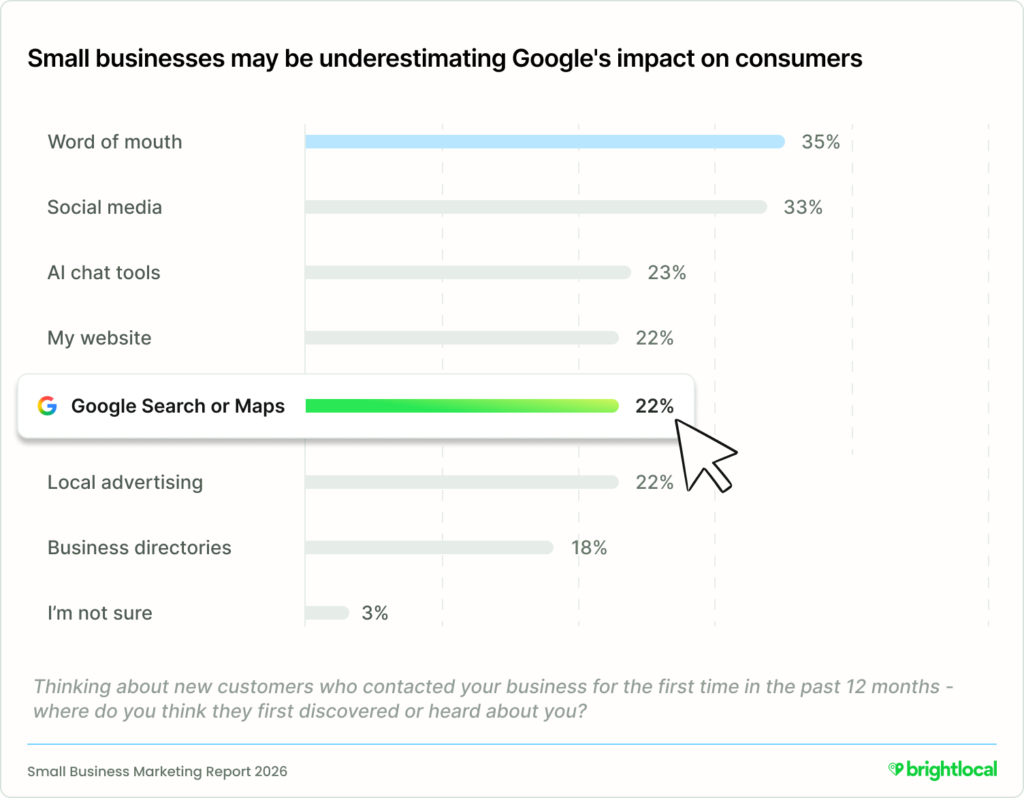
Google is still a big deal for consumers. 61% of consumers started their most recent local business search on Google. 52% used Google Search, with an additional 9% using Google Maps. They may be researching a new business to use, looking up a business they’ve heard about elsewhere, or checking its details before getting in touch.
And it’s not just about the start: 71% used Google at some point in their search, including those who started on another channel such as an AI tool and then headed to Google.
But when it comes to businesses, it’s another story.
Only 22% of the business owners named Google as one of their top two customer acquisition channels. This is a far cry from what consumers are really doing during searches. Google remains an important step in many journeys, and it shouldn’t be underestimated by businesses.
This doesn’t mean business owners are wrong about the importance of word of mouth or social media. Someone might hear about a business from a friend, then search its name to find the website or get in touch. A multi-channel approach is common among consumers, and the final touch shouldn’t be the only one for business owners to pay attention to.
22% of business owners named their website as one of their top two sources of new customers. But how do people get on your website to begin with? A customer who says they found a business through its website may have reached that website from a Google result, a social channel, an AI result, or any other channel.
AI adds another layer. Nearly a quarter (23%) of business owners named AI tools as one of the top sources of new customers – the third biggest. Small business owners recognize that AI can lead to customers. It’s particularly important for home or garden service businesses (35% named it as a top two source of new customers), beauty businesses (29%), and automotive (28%). Retailers were less likely to rank it highly (17%).
Are businesses putting energy in the wrong places?
Business owners really understand the value of showing up online. When asked how important it is for local businesses to actively manage how they appear online, 98% of business owners said it was important, with 39% calling it essential. This lines up with consumers, where 96% called it important.
98%
of business owners believe it’s important to actively manage how they appear online.
So with both in agreement that it’s important to appear active online, where are business owners putting their effort?
Business owners are most likely to have an active presence on Facebook, with 43% posting, responding to enquiries, or updating it at least occasionally. 40% also maintain an Instagram account for their business, making Meta an important part of marketing for many small business owners.
Websites are important to businesses, with 41% saying they have an active presence. As explored above, websites can be a key source of new customers, but they have a wider role to play too.
Of course, many more businesses may have a website that they don’t regularly update, but with consumers, search engines, and AI tools looking to the website for accurate information it’s important it represents the reality of your business. Businesses should regularly assess what’s on their website:
- Does it seem up-to-date?
- Are there recent reviews, testimonials, or case studies to tell your story?
- Do your services and prices reflect what happens when a customer uses you?
If any content feels out-of-date or inaccurate, update it or remove it so that it can’t cause confusion.
Keeping an active presence everywhere is hard for small businesses, and some channels will naturally get less attention. As we explore in chapter 4, owners often juggle marketing with the day-to-day running of their business. With limited time, it helps to think beyond where customers first hear about you, and prioritize the channels they use to decide whether to get in touch.
Ready to improve your rankings? Talk to us about our Local SEO Services
Where businesses are active by niche
| All businesses | Trades or home | Health or medical | Beauty or personal care | Food or drink | Professional services | Home or garden services | Independent retail | Automotive | |
|---|---|---|---|---|---|---|---|---|---|
| Facebook business page | 43% | 56% | 46% | 48% | 47% | 37% | 35% | 37% | 43% |
| A business website | 41% | 37% | 58% | 41% | 40% | 44% | 31% | 31% | 38% |
| Instagram business account | 40% | 44% | 41% | 46% | 46% | 32% | 43% | 40% | 39% |
| Google Business Profile | 35% | 38% | 52% | 39% | 35% | 33% | 32% | 21% | 40% |
| TikTok account | 31% | 29% | 45% | 43% | 31% | 28% | 25% | 24% | 40% |
| X account | 31% | 35% | 32% | 28% | 28% | 31% | 31% | 30% | 53% |
| Review sites / directories | 26% | 26% | 31% | 26% | 20% | 23% | 30% | 22% | 50% |
| LinkedIn page | 24% | 34% | 32% | 22% | 13% | 23% | 27% | 17% | 30% |
It’s a different story when looking across different industries. While trades and home repair businesses are active on Meta channels, they’re less likely to be visible on directories. Beauty, food and drink, and home and garden businesses also make Meta a priority.
Health and medical businesses lead the way with active websites (58%) and Google Business Profiles (52%). Both give potential customers somewhere to check services, find practical information, and decide whether to get in touch. This may reflect the reassurance people need when choosing a healthcare provider, from understanding the treatments available to checking who they’ll be trusting with their care.
Automotive businesses stand out for their activity across several channels, including X, directories, TikTok, and LinkedIn. Automotive businesses are almost twice as likely as businesses overall to have an active presence on review sites or directories. There are many automotive-only sites for listing vehicles, so it makes sense for this to be so active. Many other industries also have niche-specific listing sites that are worth exploring.
Even if customers don’t come directly from these sites, the information they hold can help people find you elsewhere. Our recent research uncovered that 415 directories were used as sources by LLMs when looking for information on local businesses, with Google Business Profile, Yelp, Facebook, and TripAdvisor leading the way. If a business fails to keep information up-to-date and gather reviews across the top sites, AI tools may surface outdated information, or fail to show them altogether.
Get Citations Done Fast… and Own Your Listings Forever
Google Business Profile ownership is growing, but more could be done
For a customer searching on Google (and remember, that’s 71% of them), a business’s profile can be one of the first things they see. It can help them check opening hours, find directions, or visit the website, often before they’ve reached the business’s own site.
Google is also where 71% of consumers read local business reviews, according to our Local Consumer Review Survey. Its role extends beyond discovery to helping customers decide whether a business is right for them.
While Google’s importance as a source of customers may be low, usage of Google Business Profile (GBP) is thriving. Last year, our 2025 SMB Marketing report found that only 35% of SMBs used Google Business Profile to market their business. While that survey focused on slightly larger businesses with 1-250 employees, it does make this year’s GBP figures encouraging. This year, 85% report having a GBP, with 63% managing it themselves. However, only 35% said they maintained an active presence there, meaning that there could be a lot of inactive or ignored Google profiles in the wild.
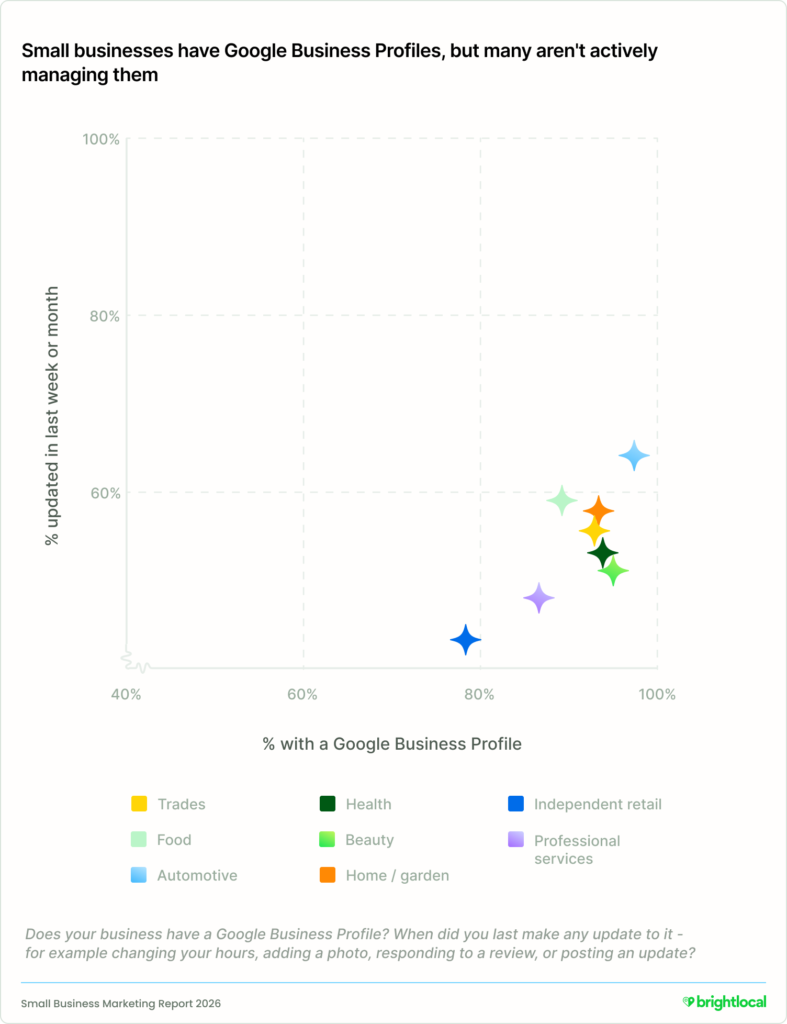
For many businesses in less competitive markets, it may feel less vital to frequently update GBP listings with new photos, Posts, or other updates. However, if you want to stand out locally and impress consumers with your active online presence, GBP can be an underrated tool.
Whether a profile is active or not can be open to interpretation. 30% said they’d updated their GBP in the last week, whether that was by changing hours, adding a photo, posting an update, or responding to a review. 72% had updated in the last three months, though 21% said it had been more than three months since they updated GBP. Automotive businesses were most likely to have updated in the last week, while retailers, professional services, and health businesses were most likely to say they’d never updated it.
But, as we discuss in chapter 2, reviews are a big priority for many local business owners. Reviews may be one reason owners regularly update their profiles, even if they don’t think of GBP as a channel they actively manage. But keeping a profile useful goes beyond responding to reviews. Customers also need to know that the hours, services, photos, and links still reflect the business today.
Explore the rest of our Small Business Marketing Report 2026 for more on how businesses manage reviews, approach AI search, and find time for marketing.
Methodology
This report was conducted using a representative panel of 1,002 US-based owners of locally operating businesses with 1-50 employees. All respondents were responsible for marketing decisions in their business. This post forms one out of four parts of the Small Business Marketing Report 2026, read the full report here: https://www.brightlocal.com/research/smb-marketing-report/
Publications and individuals are welcome to use our research findings, graphics, and data, citing BrightLocal as the author and the page URL: https://www.brightlocal.com/research/smb-report-google/