









Key findings
-
Marketing decisions sit with owners: Most take sole responsibility while juggling the day-to-day running of their business
-
Owners face barriers to improving online visibility: Complexity, cost, and lack of time stop businesses from doing more
-
The value of marketing isn’t always clear: A quarter of owners doubt marketing makes a difference, while others quit after not seeing results
Running a small business means wearing a lot of different hats: from serving customers to managing finances, ordering stock, and attracting new prospects. If you’re a plumber, hairstylist, or accountant wanting to be your own boss, you are a specialist. But owning a business often means you also need to develop new skills that might be outside your comfort zone.
Marketing can be confusing. There are lots of different channels to learn, each with its own language, algorithms, and ways of working. It requires finding the right message to find new customers, nurture them along the pipeline, and keep customers coming back for more. Doing all of this well takes time, and this is often time that small business owners just can’t find.
Across the Small Business Marketing Report series, we’ve explored the different ways that small businesses and consumers use Google, reviews, social media, and AI search. Now, we’ll look at the people behind that work, and what is stopping them from doing more. Based on the experiences of 1,000 US small business owners, we’ll outline the struggles holding businesses back from marketing success.
Business owners do most of the work
This study was aimed at small business owners in businesses with 1 to 50 employees that handle marketing decisions themselves, or share responsibility with a colleague. These included sole owners, co-owners, CEOs, and founders from businesses serving a local customer base.
85%
of small business owners take primary responsibility for marketing decisions.
Only 2% of respondents said they didn’t hold sole or shared responsibility for marketing decisions. This means that 98% of small business owners are responsible for marketing decisions, even among the bigger businesses in the study where there may be more budget for a dedicated marketer.
Small business owners know just how important it is to actively manage their presence online.
As we explored earlier in this series, business owners keep an active presence on many channels. Facebook, websites, Instagram, Google Business Profile, and TikTok are the channels small businesses are most likely to be active on. However, these don’t necessarily reflect the channels that consumers use, with most turning to Google in their most recent local search.
Small businesses know they need to actively manage their online presence. But with limited resources, this can be tricky.
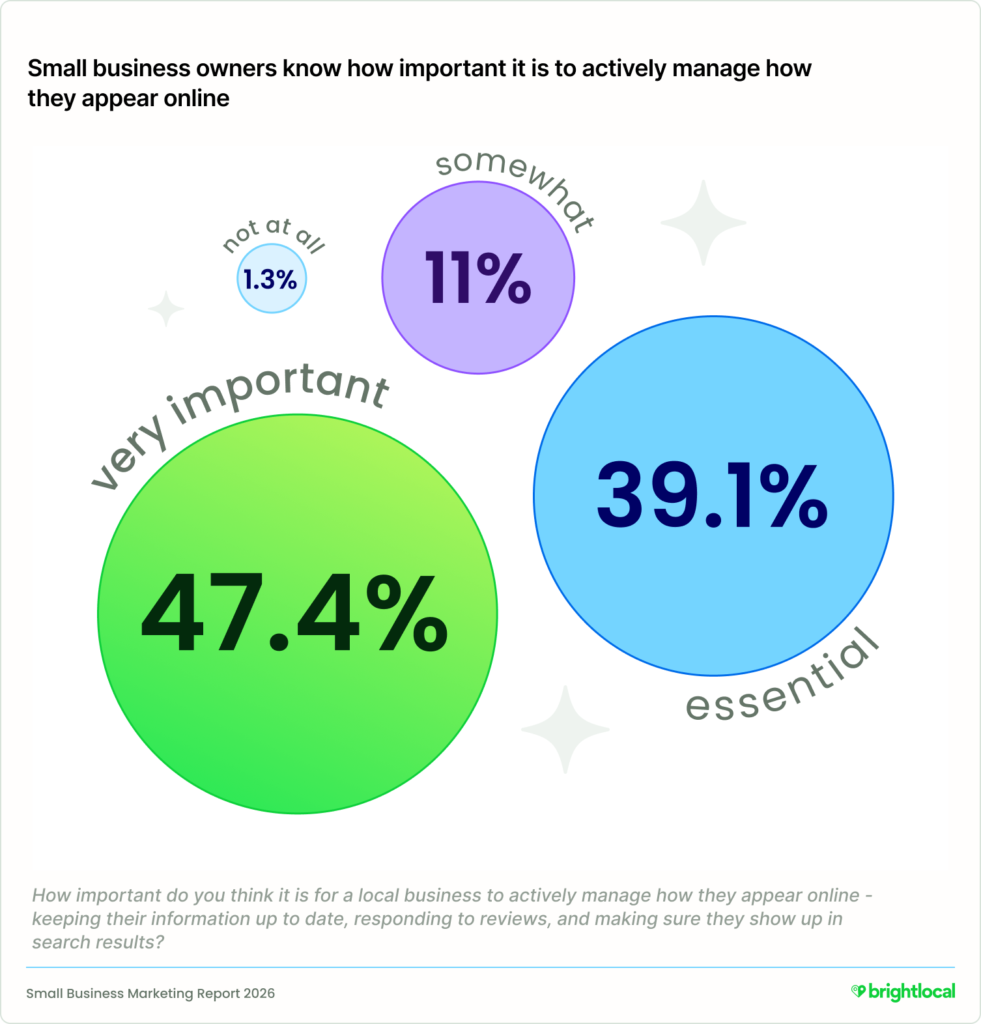
Small business marketing in 2026 takes a lot of work. Businesses need to ask for reviews and be ready to respond to them, and now there is the added pressure of upskilling on AI. With so many platforms to keep track of, it’s understandable that owners have to make choices about where their attention goes. Making those choices based on what customers actually want can help owners get more from the time they have, but knowing what to prioritize isn’t always easy.
What’s stopping small businesses from doing more?
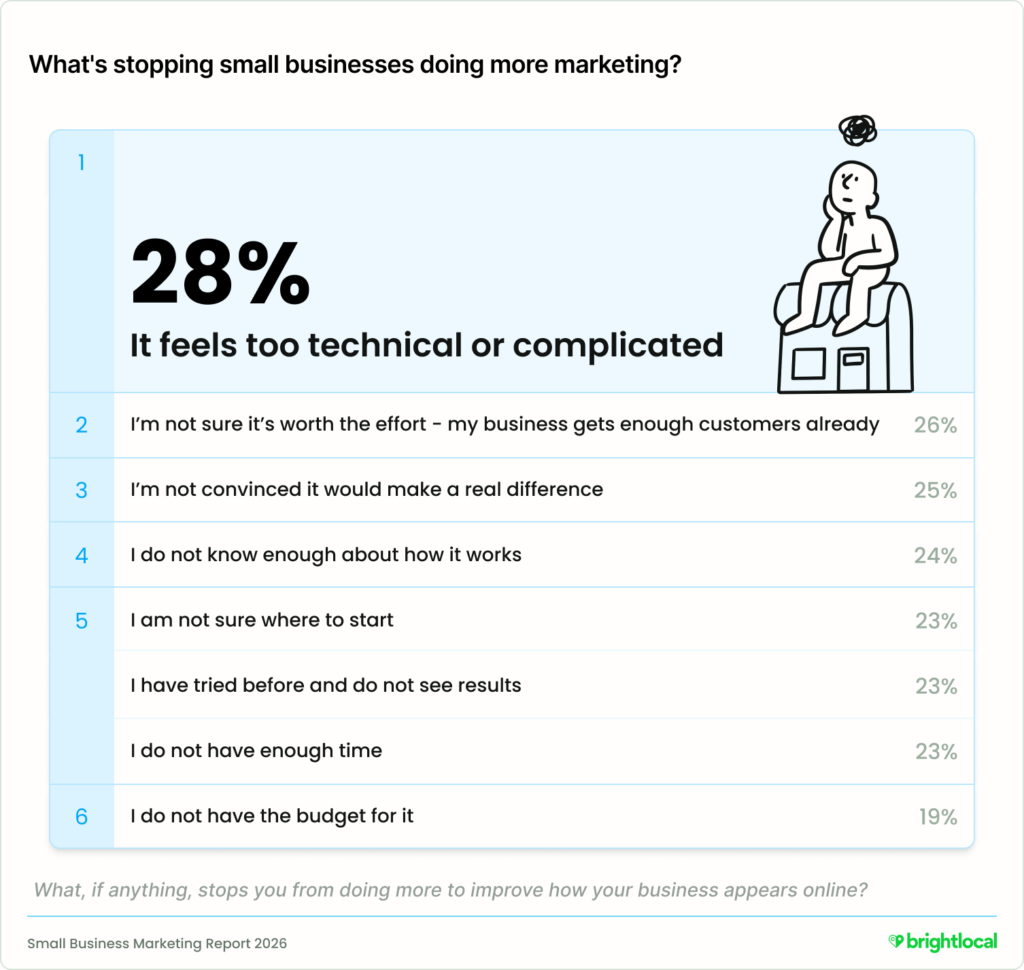
With owners juggling marketing alongside the day-to-day running of their business, what stops them from doing more to improve their online presence? We asked the small business owners to share all the barriers they face.
Marketing is too hard
The biggest reason business owners cited for not spending more time or effort on marketing is simply that it’s difficult. 28% said it feels too technical or complicated, while others said they don’t know enough about how it works or that they aren’t sure where to start.
Whether you’re a marketing beginner not sure where to start, or have done the basics but are not sure where to go from here, it can be overwhelming to pick a marketing strategy.
A useful starting point is to look at what customers find when they look for your business online:
- Does your business show up across the places your customers look? Look at Google, business listing sites, social media, and AI tools for a full picture.
- Are your opening hours and contact details correct? Make it as easy as possible for your customers to reach you.
- Does your website explain what you offer? If anything feels outdated, or there are any questions customers frequently ask, think about how these can be explained upfront.
- What do your reviews tell your customers? Read the reviews surfaced on Google Business Profile and other top review sites, and see if it paints a fair reflection of how you do business. If reviews feel outdated or unanswered, customers could assume you put the same level of effort in your service.
Free resources such as the BrightLocal Academy can help point you in the right direction.
Beginners can learn the basics with courses on starting out with local SEO, Google Business Profile, or reviews.
Businesses with more established marketing setups can take their skills to the next level with courses covering specific topics and techniques such as Google Analytics 4, creating website content, and creating a tailored local SEO strategy.
Or, if you’d prefer a list to work through at your own pace, our local SEO checklist helps break the work into manageable steps.
We’ve created a brand new YouTube series to get you started with local SEO too. You can watch episode one below:
Marketing takes too much time
Nearly a quarter of business owners (23%) said they don’t have enough time to improve their online presence. The problem with marketing is that it can take five minutes a day, or five days a week, depending on what you decide to do. And when customers are calling, it can be hard to make it a priority.
The challenge is deciding which tasks deserve the time you have. The channels that owners think bring in customers don’t always match the places consumers search. Most consumers told us they used Google in their most recent search for a local business, whether they started there, or used it to find out more about a business after discovering them on another channel. If you’re short on time, keeping your Google Business Profile accurate and visible is a useful place to start.
Of course, every business is unique. Different industries work in different ways, and only you can find out for sure where your customers are coming from. Ask new customers how they found you and continue to prioritize these channels. But also, look at where your competitors are that you aren’t: could they be finding a whole new market that isn’t aware of your existence?
Once you’ve chosen where to focus, set a routine that you can realistically keep. Check reviews at least once a week, update opening hours whenever they change, and set aside time each month to check your website and key listings for accuracy. Building these tasks into your week can make them easier to stay on top of than waiting until you have a rare spare moment.
One of the simplest ways to save time is admitting that someone else may need to do it. Before hiring someone, there are many freelancers or services that could help you on a part-time basis.
BrightLocal’s Local SEO Services are one of these, or a freelancer who just helps you with your social media could be a great place to start.
Ready to improve your rankings? Talk to us about our Local SEO Services
Marketing costs too much
Expensive tools and ad spend can quickly mount up, so it’s no surprise that 19% of business owners don’t feel able to improve their online visibility due to budget. Investing in an agency or local SEO specialist can free up significant time, but smaller businesses may not always be able to justify the cost.
But for many businesses with the time and know-how to do it themselves, marketing doesn’t need to be unduly expensive. Updating business listings, managing reviews, and optimizing your website for Google can all be done for free, with low-cost options if you’d prefer to save time on repetitive or easily automated tasks.
For agencies, being clear about what a limited budget will cover can help owners decide whether support is worth the cost. Explain what tasks you’d prioritize, how they could help bring in new customers, and how taking them off the owner’s hands would leave more time for running the business.
Marketing doesn’t make a difference
For some owners, the barrier is whether marketing will make a difference at all. 25% aren’t convinced it would make a difference, while 23% said they’ve tried in the past but didn’t see results. When time and budget are tight, it’s understandable to hesitate before investing in something that isn’t showing results.
Start by deciding what success would look like for your business. More enquiries? More bookings for a specific service? More followers on social media, or email list subscribers? A clear goal makes it easier to choose where to focus and judge whether your efforts are paying off. If they aren’t, there’s no shame in switching up tactics to reach the right audience for you.
But of course, it will also feel like marketing isn’t worth it if you aren’t paying attention to the results. Use Google Analytics to track website visits and completed enquiry forms, check Google Business Profile performance for calls and website clicks, and keep a simple spreadsheet of enquiries and where customers say they found you.
Be patient, too. One social post or website update is unlikely to bring a rush of new customers. Marketing takes consistent effort, so build it into your routine rather than treating it as a one-off task.
Marketing just isn’t needed
A lucky 26% of business owners don’t think marketing is worth the effort as they get enough customers already. Businesses in an in-demand niche or without much local competition may get enough inbound enquiries without much marketing effort.
However, that doesn’t mean that marketing should be entirely neglected. Make sure you’re aware of your online reputation by monitoring reviews and checking what is being said about you on social media and in search results. Keeping your online presence up-to-date and accurate doesn’t need a lot of time, and can save a big headache if something went wrong without you realizing.
Find out more in the Small Business Marketing Report, covering where businesses focus their marketing, how reviews compare with customer expectations, and how they are approaching AI search.
Methodology
This report was conducted using a representative panel of 1,002 US-based owners of locally operating businesses with 1-50 employees. All respondents were responsible for marketing decisions in their business. This post forms one out of four parts of the Small ]Business Marketing Report 2026, read the full report here: https://www.brightlocal.com/research/smb-marketing-report/ .
Publications and individuals are welcome to use our research findings, graphics, and data, citing BrightLocal as the author and the page URL: https://www.brightlocal.com/research/smb-report-who-owns-marketing/