









Key findings
-
Review management is on owners’ to do lists: Most keep an eye on Google reviews, but don’t always reply as consumers expect
-
Google reviews counts fall short: Many small businesses don’t have enough reviews to match customer expectations
-
Some industries are further ahead on reviews: Automotive and food businesses have stronger review counts, while professional services lag behind
Reviews play a key part in the decision-making process for many consumers, helping them decide if a business can meet their needs and be trusted. But do businesses realize how vital they are?
Over the summer, we explored how consumers find and choose local businesses online. In this, we learned that reviews are one of the top signals searchers look for when choosing a business, helping people compare options and decide who to trust. Our long-running Local Consumer Review Survey also shows that star ratings and recent reviews matter more than ever for customers.
But does this line up with what businesses are actually doing? We asked 1,000 US-based small business owners how they market their business, and where reviews feed into this.
The good news is that many business owners are putting in the effort. As part of the Small Business Marketing Report (all parts available now!), we’ll look at where that effort is paying off, where it falls short of customer expectations, and what businesses can do to close the gap.
Businesses are making reviews a priority
Our Consumer Search Behavior study found that 30% of consumers named reviews as the deciding factor during their most recent online search for a local business. 27% also chose the business with the best star rating. Reviews made the biggest difference throughout the journey of finding a local business, from first search all the way to final decision.
As we discussed in chapter 1, 85% of businesses have a Google Business Profile, though whether they use it to its full potential is another story. Just 35% said they had an active presence here, and only 22% saw Google as one of their top customer acquisition channels.
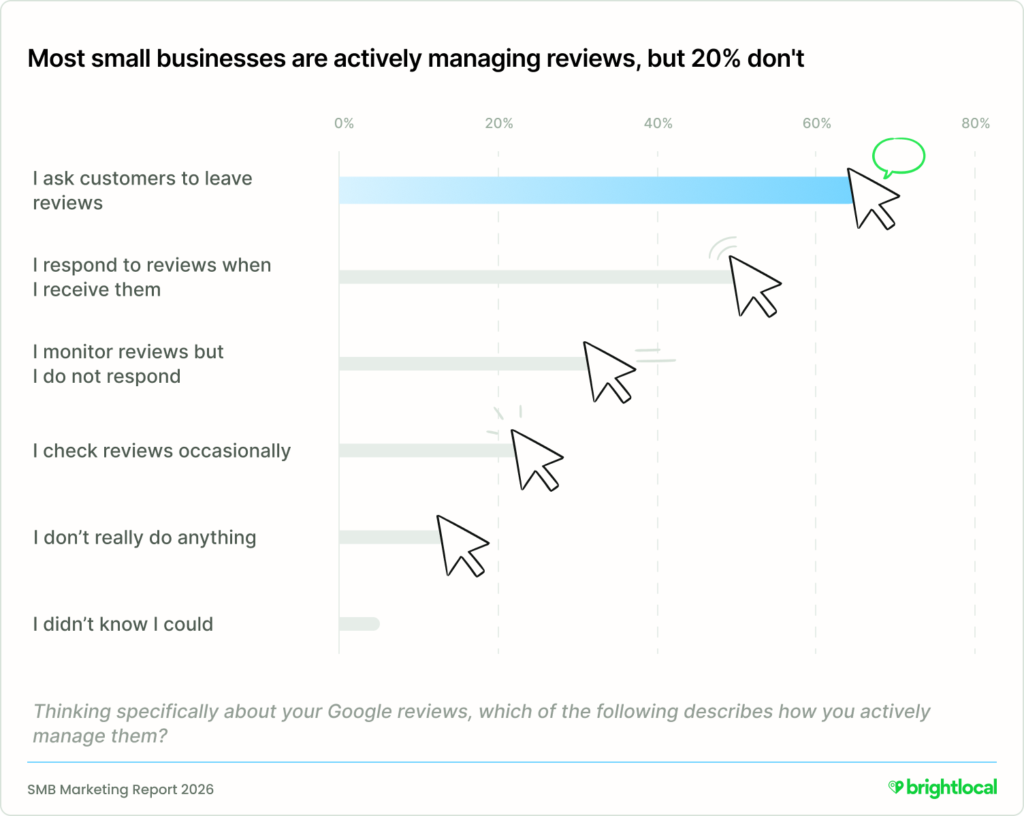
Like consumers, businesses understand reviews matter. 80% have some sort of review management process for Google. Some monitor reviews but don’t always reply, while others check occasionally without a regular process.
But 14% said they don’t really do anything, while 6% didn’t even know they could manage or respond to Google reviews.
Even though most business owners are keeping an eye on Google reviews, that doesn’t mean everyone is responding to them. The 2026 Local Consumer Review Survey found that 89% of consumers expect business owners to respond to reviews, with 42% saying they were unlikely to use a business that ignores its reviews. Yet, only 51% of business owners actually respond to reviews.
Half of businesses could be putting off potential customers by ignoring feedback.
Replying to reviews matters more than responding to just the reviewer. It shows potential customers that you care about their experience and can give additional information that can’t be found elsewhere. Make responding part of your regular review checks, with replies that address what each customer has actually said.
It’s great that so many businesses are actively asking customers for reviews, with 64% doing this regularly. While not every review platform allows this, asking for reviews can often tip customers into leaving feedback that they might not have thought to do otherwise.
How many Google reviews do businesses have?
A handful of glowing reviews can let potential customers know a business is legit, but do businesses have enough to impress the majority of customers?
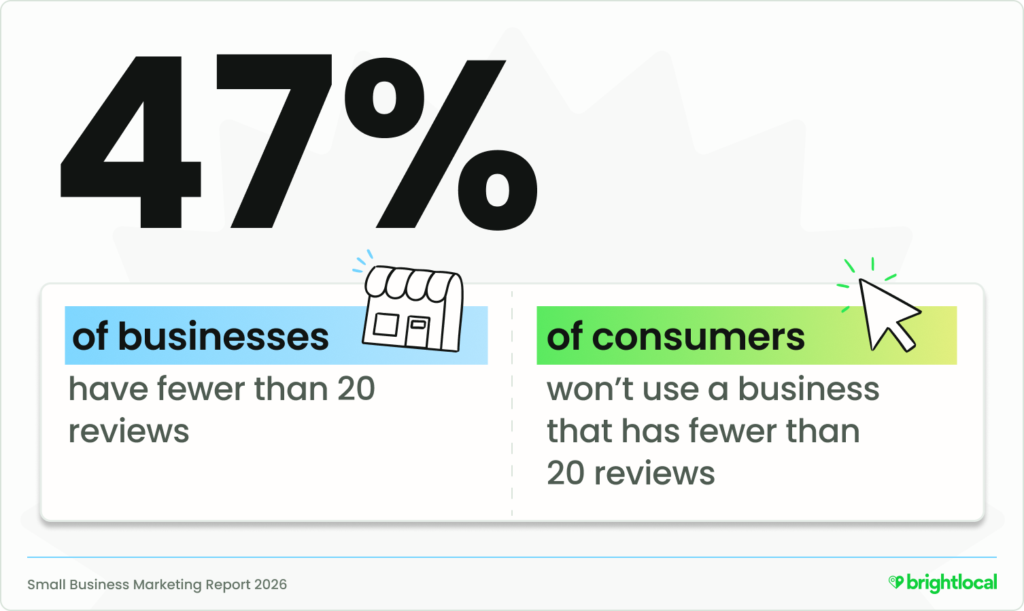
47% of small businesses have fewer than 20 Google reviews. Yet, the same proportion of consumers won’t use a business that has this number.
Businesses that aren’t focusing on growing reviews on Google could end up deterring customers just by the limited number of reviews. And it’s not only customer count that could be harmed, as Google reviews can play a part in how well you rank for Google local searches.
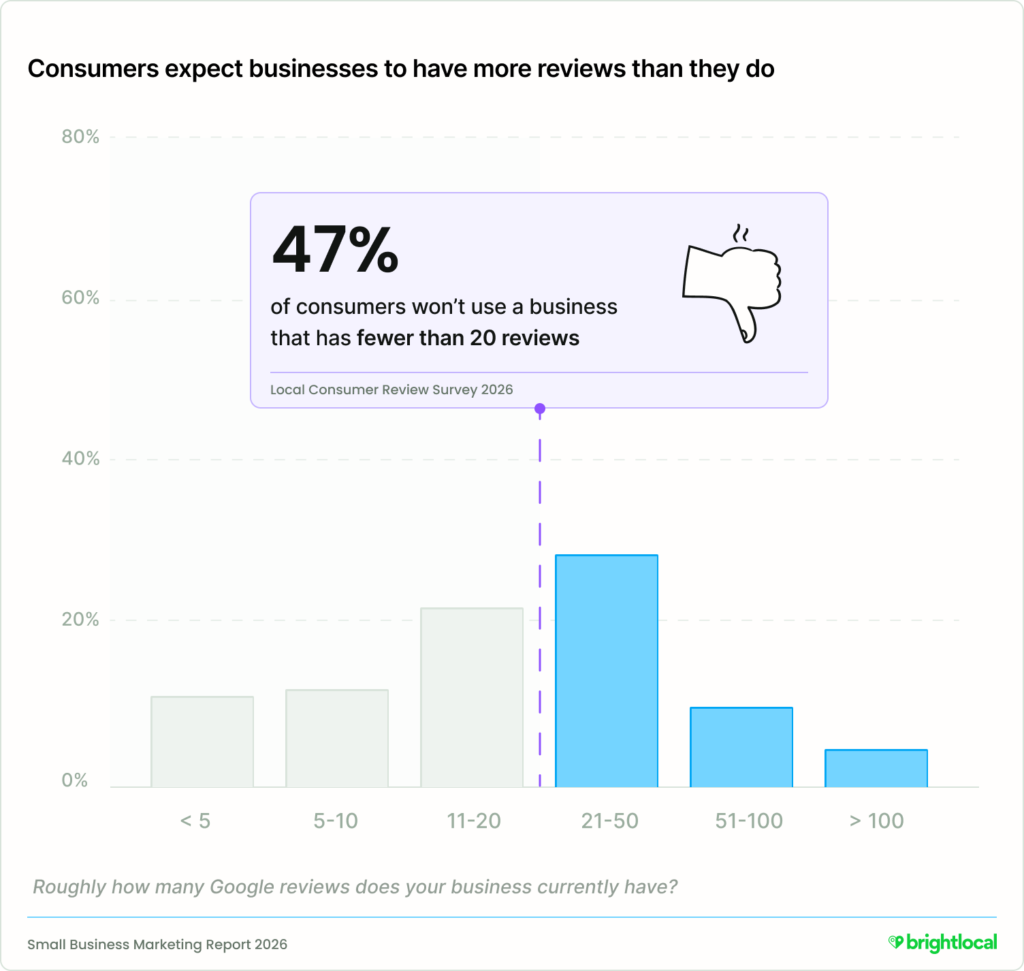
Some businesses have built a larger review count, with 16% saying they have more than 50 Google reviews. But the total only tells part of the story.
The data finds that newer businesses tend to have fewer reviews than those that are longer-established. However, it’s not a lost cause for businesses just starting out, as the Local Consumer Review Survey found that consumers far prefer reviews written in the last three months. A business with hundreds of reviews might appear well established, but if its latest feedback is from years ago, customers may wonder whether it still offers the same experience.
That’s encouraging for newer businesses, which won’t have had years to build up a large total. It also means reaching 20 reviews isn’t a finish line. Asking customers consistently helps build a picture of what it’s like to use your business today, as well as growing your overall count.
Businesses that ask have more reviews
It’s even better news for business owners that ask for reviews. 57% of businesses that ask for reviews have 11-50 Google reviews (compared to 50% of people that don’t ask), and 19% have more than 50 (compared to 15%).
In fact, 94% of consumers are open to writing reviews, with the average consumer writing between 4 and 6 reviews a year. Consumers are actually more likely to write a positive review than a negative one, so businesses shouldn’t worry too much about opening the floodgates by asking for feedback.
The challenge is making the request consistent. If asking depends on an owner remembering at the end of a busy day, plenty of opportunities will pass by. As we explore in chapter 4, finding time for marketing is a challenge for many owners, so where possible, build the request into something you already do, such as a thank-you email after an appointment or an invoice sent once a job is complete.
Requests should be simple, timely, and open to honest feedback from every customer. This helps build a review profile reflecting the full customer experience, rather than a hand-picked set of glowing comments.
Read more: How to ask for reviews (with templates)
Every industry is different
| All businesses | Trades or home | Health or medical | Beauty or personal care | Food or drink | Professional services | Home or garden services | Independent retail | Automotive | |
|---|---|---|---|---|---|---|---|---|---|
| Regularly ask for reviews | 64% | 69% | 79% | 73% | 64% | 63% | 77% | 58% | 76% |
| Respond to reviews | 51% | 56% | 58% | 57% | 60% | 45% | 48% | 55% | 63% |
| Have fewer than 20 reviews | 47% | 54% | 50% | 50% | 35% | 50% | 47% | 44% | 41% |
| Have 21-50 reviews | 28% | 34% | 33% | 33% | 33% | 24% | 26% | 28% | 28% |
| Have more than 50 reviews | 16% | 9% | 14% | 15% | 21% | 18% | 26% | 12% | 27% |
When looking across industries, there’s no one story on Google reviews.
Automotive businesses are the most likely (27%) to have more than 50 Google reviews, which lines up with automotives’ strong use of Google Business Profile and prioritization of Google as a channel as found in chapter 1. They’re also the most likely to respond to reviews (63%).
Health and medical businesses are the most likely to regularly ask for reviews (79%), yet half still have fewer than 20. Asking is a useful starting point, but it’s worth checking whether those requests actually lead to feedback. Customers may not want to share health-related information in a public place, so consider how you can word requests that make them feel comfortable sharing more generic feedback.
Professional services businesses are lagging behind in review count, with 28% saying they have fewer than 10. They were also the worst at responding to reviews, though they do ask for them. Yet, in our Consumer Search Behavior study, we found that people paid very close attention to review count and star rating for professional services businesses.
38%
of consumers look at the star rating of a business during the research phase.
In industries where consumers are looking to trust a business with their health, home, or with a big-ticket purchase, a small number of reviews may leave them with less evidence to judge a business at the point they want reassurance.
Food and drink businesses tell a more positive story. Just 35% have fewer than 20 Google reviews, the lowest proportion of any industry in our survey, while 21% have more than 50. Their rate of asking for reviews is in line with the overall average, but they’re among the most likely to respond to them (60%). That suggests review counts don’t depend on asking alone. The number of customers a business serves, how often they return, and how much the product inspires a review can also shape overall count.
Make review management part of your routine
Small businesses are making an effort with reviews. Many ask customers for feedback, monitor what comes in, and respond. But is this enough to make people feel confident choosing you over a competitor?
Start by looking at your Google reviews as a potential customer would:
- How many reviews are there?
- When was the most recent one posted?
- Do your responses show that you listen to customers?
Make asking for honest feedback and responding to reviews part of your regular customer follow-up. Keeping on top of this across multiple sites can take time that many business owners just don’t have, so software such as BrightLocal’s review management software can help monitor and respond to reviews quickly. A steady stream of new reviews gives your next customer a clearer picture of what they can expect from your business.
Explore the other parts of our 2026 Small Business Marketing Report to see how businesses approach Google, AI search, and the challenges of doing their own marketing.
Methodology
This report was conducted using a representative panel of 1,002 US-based owners of locally operating businesses with 1-50 employees. All respondents were responsible for marketing decisions in their business. This post forms one out of four parts of the Small Business Marketing Report 2026, read the full report here: https://www.brightlocal.com/research/smb-marketing-report/
Publications and individuals are welcome to use our research findings, graphics, and data, citing BrightLocal as the author and the page URL: https://www.brightlocal.com/blog/smb-report-enough-reviews/.