- AI enters the mainstream, with 45% consumers using AI tools for local business recommendations (up from 6% last year)
- ChatGPT is leading the way, though Google’s AI tools are second in line
- AI outranked traditional review platforms, Yelp and TripAdvisor, for local consumers looking for recommendations
- Millennials are most likely to ask AI for a local business recommendation, while over 60s remain cautious
- Consumers remain wary, with most (88%) fact-checking reviews cited by AI tools
Since 2010, the Local Consumer Review Survey has been our window into how people discover and choose businesses using reviews.
This year, one story stands out above the rest: the rapid rise of AI.
In this mini-report, we go beyond the findings of the main Local Consumer Review Survey with exclusive insights exploring how consumers are using AI for local business recommendations. You’ll learn who is using AI, which tools are most popular, how much consumers trust AI-generated recommendations, and what this all means for your local strategy.

"Consumers are looking for information in more places, more often."
Myles Anderson, Co-founder and CEO at BrightLocal
What’s incredibly clear is that businesses that operate with a ‘Google-only’ mindset are at high risk of missing out on customers and revenue. We’re seeing a 12% drop in consumers relying solely on Google for reviews, while platforms like TikTok, Apple Maps, and ChatGPT are seeing double-digit growth as business discovery platforms.
It’s not that consumers are abandoning Google. After all, usage of Google AI Mode and Gemini is surging. It’s that their journey from idea to purchase has become much more fragmented. They are looking for information in more places, more often.
Crucially, the likes of ChatGPT and other LLMs and AI search tools can’t see inside Google’s walled garden of reviews. If your reputation only exists on Google, you are effectively invisible to the millions of people using ChatGPT to find local services. To be successful now, you need a ‘Reviews Everywhere’ strategy. By building your authority across Google plus the specific sites where your customers and AI models actually spend their time, you ensure your brand is present and trusted at every possible point of discovery.
Online Reviews vs. AI Recommendations
Before we dive into the data, one quick note on how AI recommendations differ from traditional reviews. Review platforms like Google Business Profile or Yelp display reviews written by real customers, which typically include a star rating, user-supplied photos or videos, and an explanation of the person’s experience.
AI tools like ChatGPT, CoPilot, and Gemini work differently. When someone asks a question (or a “prompt”), these tools analyze information from across the internet and generate a tailored response. AI responses may include information from reviews, as well as local directories, businesses’ websites, social media, and other third-party sources, depending on the tool and the prompt.
AI doesn’t “read” reviews in the same way humans do. Instead, it looks for patterns across multiple sources to quickly surface insights. While this makes it a powerful time-saving tool, recommendations aren’t always fully up to date, and key nuances from individual reviews can be lost. Even when sources are provided, the reasoning behind the results isn’t always clear. For this reason, AI works best as a starting point for discovery rather than a replacement for reading real customer experiences.
AI is changing how people find local businesses, but trust still drives decisions. For local businesses and marketers, getting to grips with AI’s role in reputation is essential for staying competitive in 2026.
Recommendations by ChatGPT

Recommendations by Google AI Mode

Recommendations by CoPilot

The Rise of AI in Local Recommendations
AI is no longer niche: it’s quickly becoming mainstream.
In early 2025, Consumer Search Behavior data found that 40% of consumers actively use generative AI when searching online. Just 3% of consumers considered an AI platform as their default for local searches.
Less than a year on, we’re already seeing significant growth in AI as a channel for local searches. Local Consumer Review Survey data finds that the proportion of consumers using AI to find local business recommendations has climbed from 6% in 2025 to 45% today.
Until recently, early users deliberately sought out these tools, but as AI becomes more widespread and embedded in the platforms people already use, even more consumers are likely to embrace it as part of their local decision-making.
AI has grown quickly over the past year to become the third most used tool for local business recommendations, behind only Google and Facebook, and outpacing major players Yelp and TripAdvisor.
At the same time, the use of Google reviews has slipped from 83% last year to 71%. Many are speculating that AI tools are shifting consumer behavior, contributing to significant declines in organic search traffic. It seems that these drops are causing a knock-on effect on the number of consumers using Google to read reviews.
AI use for local recommendations varies by age. Adults aged 30-44 lead the way, with 64% having asked AI tools for a business recommendation in the past year. Those over 60 are the most cautious, with just 24% turning to AI for local business guidance.

Understanding which AI tools are most popular helps marketers prioritize where to focus visibility efforts. ChatGPT is the clear frontrunner among consumers, being used by 31% for business recommendations in the last 12 months. Following behind is Google’s AI Mode (23%), and then Gemini, another Google-owned tool. Microsoft Copilot and Claude fall behind, but are still being tested by consumers at a far higher rate than last year.
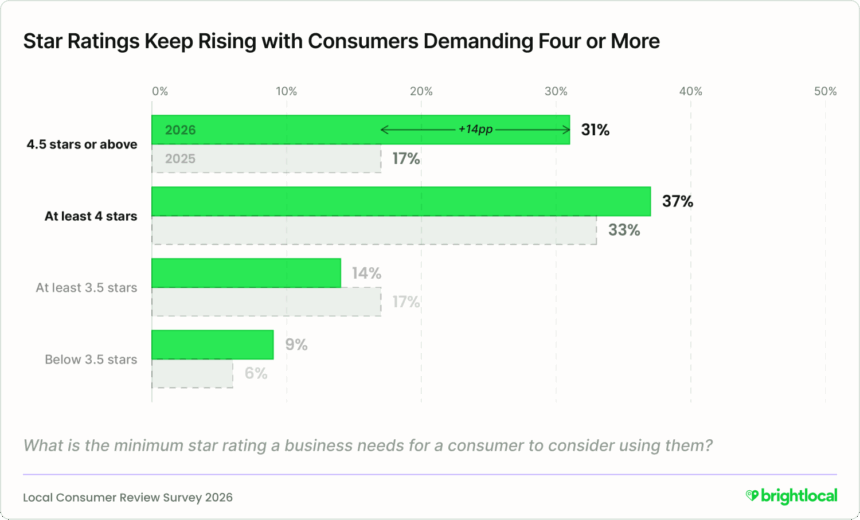
Together, these trends show that AI is moving beyond early experimentation. With millions of consumers already turning to AI to discover businesses, being visible in these tools is quickly becoming as important as a strong presence in traditional search results. But, for AI to have a long-term impact, consumers need to feel able to trust its recommendations.
Trust Levels Differ Between AI Natives and Skeptics

With AI usage growing rapidly, we wanted to understand how consumers really feel about recommendations from non-human sources.
Among active AI users, nearly two-thirds (63%) trust AI tools’ recommendations, while only 10% express distrust. Trust is significantly lower among those who don’t use AI, with 53% saying they don’t trust its business recommendations.
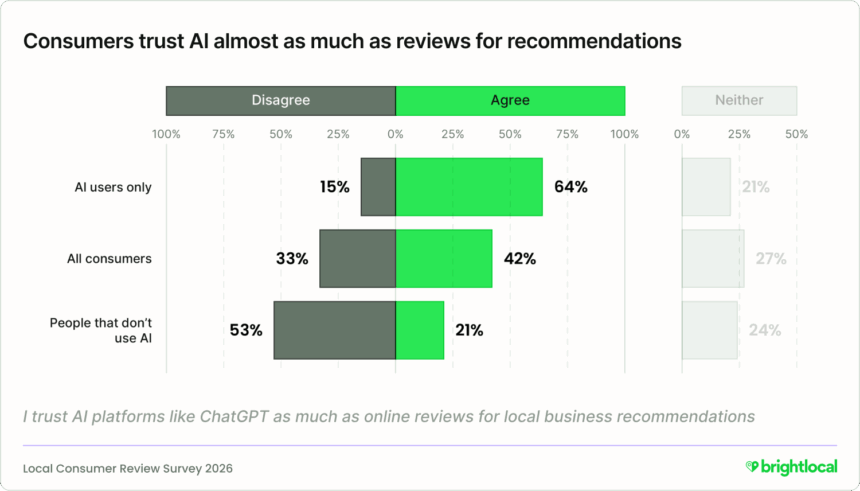
Trust in AI tools is surprisingly high when compared to reviews.
Despite online reviews being a normal part of consumer research for more than two decades, AI platforms are already being equally trusted by 42% of consumers. 64% of AI users trust tools like ChatGPT as much as reviews when making local business recommendations, though trust levels are much lower among those who haven’t yet tried AI.
In the marketing world, there has been plenty of skepticism around the accuracy of AI tools, especially when some tools “hallucinate” facts or figures. It is always wise to fact-check AI insights, just as you would any data source. When used thoughtfully, AI can be a powerful tool to help both consumers and marketers make quicker, more informed decisions. It is not a replacement for strategic thinking, but a way to free up time to focus on the bigger picture.
Summaries Could be the Gateway to AI Adoption

AI can do more than recommend businesses; it can also condense customer feedback into easy-to-digest summaries.
Tools like ChatGPT can generate full summaries of reviews in response to prompts, while platforms such as Amazon and Google are testing AI summaries of customer reviews. These summaries help consumers spot key themes and overall sentiment quickly, without having to read every review. But are these AI-generated summaries trusted to give an accurate picture of real reviews?
50% of consumers trust AI platforms to accurately summarize online reviews from real people. Among active AI users, this figure climbs to 71%. In fact, levels of trust in summaries are higher than those of AI recommendations overall, suggesting that the more these overviews are rolled out by review platforms, the more consumers may be willing to trust AI information in other places.
AI users appear to be generally trusting of AI review summaries, with only 9% not trusting the information given. People who don’t use AI are unsurprisingly less trusting, though they do appear to be a little more trusting of AI summaries than AI tools in general for local recommendations.

Consumer behavior with AI-generated review summaries varies. 23% of people are happy to rely on just the summary when making a decision, while 59% check review profiles for more information. Just 18% skip over summaries entirely, showing they are already an important tool in the decision-making process.
A strong review summary can help consumers spot patterns and sentiment without having to read hundreds of reviews. However, details such as photos, specific experiences, and the date the review was posted may be glossed over. For consumers making a major purchase, it still pays to read full reviews to make sure nothing has been missed.
This shift brings both opportunity and responsibility for businesses and marketers. AI summaries are shaped by customer reviews, making patterns in feedback more visible than ever. Taking a proactive approach to AI should make recommendations work in your favor. Ensure your business is visible for common prompts, check the accuracy of claims and correct information online where needed, and ask for reviews that highlight the qualities you want reflected.
Wary Consumers Fact-check Trusting AI Recommendations
AI has become a trusted source of local recommendations for many consumers. But this doesn’t mean people are blindly trusting the information.

Most AI users are careful to fact-check sources, with 88% of AI users checking to see if a review is legitimate (51%) or to see the source (37%). Just 12% don’t check AI sources, showing that even among early adopters, trust is still being built.

97% of AI users sometimes double-check AI recommendations against real reviews. This suggests that for many, AI has become the first step in local business research rather than the final authority. 42% always check reviews on native review platforms, with others checking occasionally. Consumers still want to see the original context and feel sure that AI recommendations match the truth.
For local businesses, this has clear implications. Consumers are actively visiting review sites to verify information. This means a weak or outdated review presence could damage trust at the decision stage. Responding to reviews, encouraging customers to add photos, and completing all parts of a review profile can make a real difference in guiding confident decisions.
Why AI Should Matter to Local Marketers
This year’s Local Consumer Review Survey tells the story of moving consumer expectations around reviews, with AI acting as a key driving force behind this change. Overtaking long-standing review sources, AI is quickly becoming essential for local discovery.
Trust in AI recommendations is developing quickly, but most AI users continue to fact-check information by checking sources and reading real reviews. This means brand reputation, active review profiles, and accurate information are more important than ever. Marketers who understand how AI interprets reviews, citations, and business data will be best positioned to guide customers and improve visibility in 2026.
For agencies and marketers, this means shifting from tactical execution to strategic guidance. Businesses that aren’t appearing in AI recommendations will want to act quickly, and marketers have an opportunity to be the partners to help them ‘rank’. Local marketers are perfectly placed to step in as the reassuring expert: collecting reviews, improving visibility, and guiding businesses through this new era.
AI is reshaping local discovery, and the pace of change is only accelerating. Explore BrightLocal’s AI Roadmap to see the tools BrightLocal is building to help marketers turn data into action.
Methodology
The Local Consumer Review Survey 2026 was conducted using a representative panel of 1,002 US adult consumers via SurveyMonkey. To give the full picture of AI and online reviews in this report, some data has been cut to include only the 455 respondents who have used an AI tool for local business recommendations in the last 12 months (“AI users”).
Publications and individuals are welcome to use our research findings, graphics, and data, citing BrightLocal as the author and the page URL: https://brightlocal.com/research/local-consumer-review-survey.